
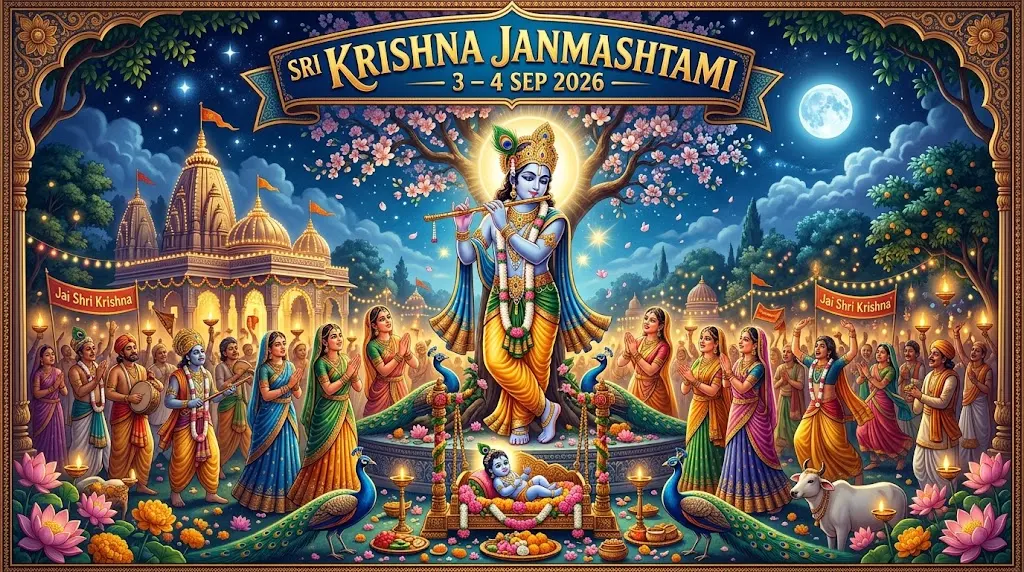
When the night becomes quiet and temple bells begin to ring, millions of devotees across India prepare to welcome the birth of Lord Krishna. Families decorate their homes, children dress as little Krishna, temples glow with flowers, and devotional songs fill the air. Sri Krishna Janmashtami – 3 – 4 Sep 2026 brings together faith, family, spirituality, and the joyful traditions of Indian culture. The festival celebrates Krishna, whose life teaches devotion, courage, wisdom, love, and the importance of following dharma. In 2026, the main Janmashtami observance in India falls on Friday, September 4, while references to September 3–4 can appear because Panchang calculations and traditions may differ. Whether you visit a temple, observe a fast, sing bhajans at home, or simply remember Krishna with love, the festival offers a beautiful chance to bring positivity and devotion into everyday life.
Krishna Janmashtami 2026 Date in India and Why September 3–4 Appears
For most Indian calendars, Krishna Janmashtami 2026 is observed on Friday, September 4, 2026. The important lunar observance is Krishna Paksha Ashtami, the eighth tithi of the waning moon. Current Panchang references place the Ashtami Tithi from early September 4 until shortly after midnight on September 5 in India.
The phrase September 3–4 can create confusion because festival dates are determined by lunar tithi, not simply by the Gregorian calendar. Some traditions and calendars may describe the observance window differently. The exact date should therefore be checked according to the family tradition, sampradaya, temple, and local Panchang.
For practical planning, September 4 is the key date for the main 2026 celebration across most of India. The midnight rituals then continue into the early hours of September 5 in many cities.
- Krishna Janmashtami 2026 falls mainly on Friday, September 4.
- The festival celebrates the divine birth of Lord Krishna.
- Krishna Paksha Ashtami is central to the Janmashtami observance.
- The main celebration takes place during the night.
- Midnight worship is one of the most important Janmashtami traditions.
- September 5 appears in calendars because midnight rituals cross into the next day.
- Some traditions may calculate the observance differently.
- Local temples may announce their own festival schedule.
- Families should follow their customary Panchang for religious rituals.
- The safest approach is to confirm the final date and timing for your city.
Ashtami Tithi and Rohini Nakshatra in Janmashtami 2026
The lunar details are important because Janmashtami is linked to the birth circumstances traditionally associated with Krishna. For a reference calculation in India, Ashtami Tithi begins around 2:25 AM on September 4, 2026, and ends around 12:13 AM on September 5. Rohini Nakshatra begins around 12:29 AM on September 4 and ends around 11:04 PM the same day in the cited Panchang calculation.
These times are not universal clock times for every Indian city. Sunrise, sunset, and the local midnight moment change with geography. That is why readers in Delhi, Mumbai, Kolkata, Chennai, Bengaluru, Ahmedabad, Jaipur, or another city may see slightly different timings.
- Ashtami means the eighth lunar day.
- Krishna Paksha refers to the waning phase of the moon.
- Ashtami Tithi is the key lunar phase for Janmashtami.
- Rohini Nakshatra is traditionally associated with Krishna Janmashtami.
- In 2026, Ashtami begins early on September 4 in many Indian Panchang calculations.
- Rohini begins around the early hours of September 4 in the reference calculation.
- Rohini continues through much of September 4.
- The exact tithi timing depends on location.
- Devotees should use their city-specific Panchang for ritual decisions.
- Tithi and Nakshatra help explain why Janmashtami dates can look different across calendars.
Nishita Kaal and Krishna Puja Timing for 2026
Nishita Kaal is the special midnight period associated with Krishna Janmashtami worship. It is especially important because Krishna is traditionally believed to have appeared at midnight in Mathura. In a New Delhi reference calculation, Nishita Puja is around 11:57 PM on September 4 to 12:43 AM on September 5. Other cities have different local windows.
For example, published city calculations show earlier or later windows in places such as Kolkata, Mumbai, Pune, Chennai, and Bengaluru. This difference is normal and comes from local astronomical calculations.
- Nishita Kaal is the midnight period used for Krishna worship.
- Krishna Puja is traditionally performed during Nishita Kaal.
- The 2026 midnight worship begins on the night of September 4.
- In many cities, the puja continues into September 5.
- New Delhi has a reference window close to 11:57 PM to 12:43 AM.
- Kolkata can have a noticeably earlier Nishita window.
- Mumbai and Pune can have a later midnight window.
- Local Panchang timing is better than using a national clock time.
- Temple schedules may adjust the public program around their rituals.
- Devotees should check the final local Nishita Kaal before beginning the main puja.
Lord Krishna Birth Story: From Mathura to Gokul
The traditional Krishna birth story begins in Mathura, where Devaki and Vasudeva were imprisoned by the cruel ruler Kamsa. A prophecy warned Kamsa that Devaki’s eighth child would become the cause of his downfall. Fear made him cruel, and he tried to prevent the prophecy from coming true.
Krishna was born to Devaki and Vasudeva at midnight. According to the traditional account, Vasudeva carried the newborn Krishna across the Yamuna to Gokul. There, the child was placed in the care of Nanda and Yashoda. Krishna’s childhood in Gokul became a beloved part of Indian devotional culture.
The story is remembered not only as a divine birth but also as a message of hope during difficult times.
- Devaki is remembered as Krishna’s birth mother.
- Vasudeva protected the newborn Krishna during a dangerous night.
- Kamsa represents fear, cruelty, and misuse of power in the traditional story.
- Mathura is revered as the traditional birthplace of Krishna.
- The journey to Gokul is one of the most memorable parts of Krishna’s birth story.
- Nanda and Yashoda lovingly raised Krishna in Gokul.
- The Yamuna is closely connected with Krishna’s childhood traditions.
- Krishna’s birth story reminds devotees that hope can appear during darkness.
- The story highlights courage in the face of injustice.
- The birth of Krishna is celebrated as a victory of righteousness over wrongdoing.
Why Krishna Janmashtami Is Spiritually Important
Janmashtami is much more than a birthday celebration. It gives devotees an opportunity to reflect on the values associated with Krishna. His teachings emphasize duty, devotion, wisdom, self-control, courage, and righteous action.
The Bhagavad Gita is especially important in understanding Krishna’s spiritual message. Its teachings encourage people to perform their duty with sincerity while remaining steady through success and failure.
Janmashtami therefore invites people to celebrate outwardly while also looking inward.
- Janmashtami reminds devotees to keep faith during difficult moments.
- Krishna’s teachings encourage sincere action.
- Dharma means living according to righteousness and duty.
- Devotion can bring discipline and inner strength.
- Krishna’s life is connected with courage and wisdom.
- Compassion is an important part of spiritual living.
- Self-control helps people make better choices.
- The Bhagavad Gita encourages thoughtful and responsible action.
- Love and devotion give deeper meaning to celebration.
- Janmashtami can become a day for spiritual reflection, not only festivity.
Janmashtami Fasting Rules and Parana Traditions
Fasting is a common Janmashtami practice, but there is no single method followed by every devotee. Families and religious traditions may observe different forms of fasting. Some people avoid grains, some take fruits and milk, while others observe a stricter fast.
The timing of Parana, or breaking the fast, also varies according to tradition. Some Panchang traditions recommend waiting until specific tithi and Nakshatra conditions are completed, while others follow a customary post-midnight practice. Current 2026 Panchang references show these differences clearly.
- Janmashtami fasting is traditionally observed with devotion and discipline.
- Fasting practices differ between families and regions.
- Some devotees eat only permitted fasting foods.
- Fruits and milk are common choices for lighter fasting traditions.
- A strict fast should not be treated as compulsory for everyone.
- People with special dietary needs should follow appropriate personal guidance.
- Parana means ending or breaking the fast.
- Parana timing depends on the religious tradition being followed.
- A local Panchang should be checked before deciding the exact Parana time.
- The spiritual purpose of fasting is devotion, discipline, and remembrance of Krishna.
Krishna Puja, Bal Gopal Worship and Midnight Celebration
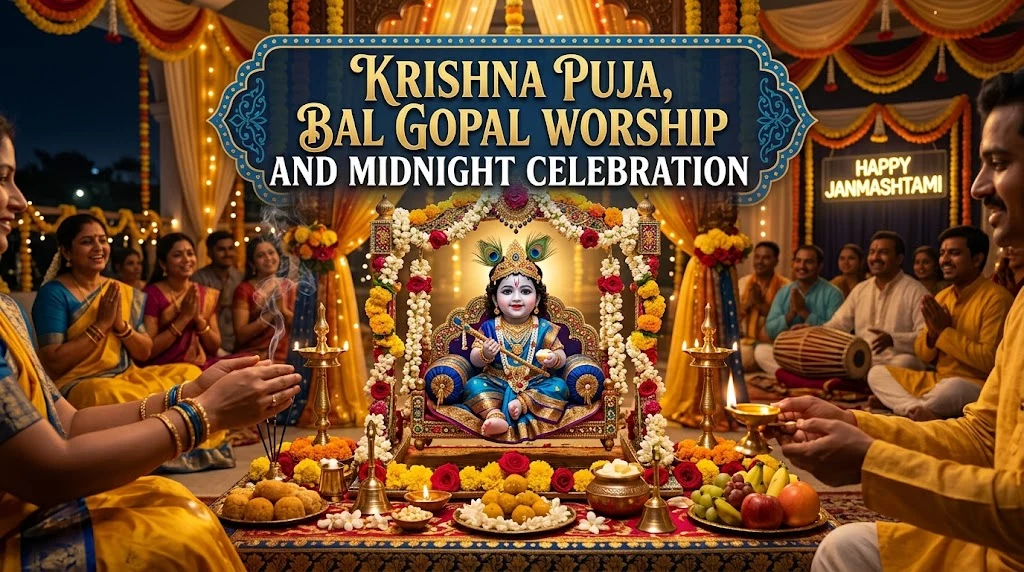
One of the sweetest parts of Janmashtami is the worship of Bal Gopal, the child form of Krishna. Homes and temples may prepare a small decorated space for Krishna. Devotees offer flowers, fruits, sweets, butter, milk, and other traditional offerings.
At midnight, families may perform aarti, sing bhajans, ring bells, and welcome Krishna with joy. Some temples perform elaborate rituals, while home celebrations can be simple and peaceful.
- Clean the puja space before beginning the celebration.
- Decorate the Krishna idol or image with clean and suitable items.
- Offer flowers as a simple expression of devotion.
- Prepare traditional bhog according to family custom.
- Include milk or dairy offerings where suitable.
- Sing devotional bhajans during the evening.
- Perform aarti at the customary time.
- Welcome Bal Gopal with a peaceful and loving heart.
- Keep the midnight ritual focused rather than overly complicated.
- End the worship with gratitude and prayers for family well-being.
Mathura Janmashtami and the Sacred Birthplace Tradition
Mathura holds a special place in Krishna devotion because it is traditionally regarded as Krishna’s birthplace. During Janmashtami, the city becomes a major center of pilgrimage and devotional activity.
Temples, streets, and religious spaces prepare special programs. Devotees gather for prayers and midnight celebrations. The atmosphere reflects the connection between Krishna’s birth story and the living culture of Mathura.
- Mathura is traditionally associated with Krishna’s birth.
- Krishna Janmabhoomi is an important pilgrimage reference for devotees.
- Janmashtami brings large devotional gatherings to Mathura.
- Midnight celebrations are central to the city’s festival atmosphere.
- Temple decorations create a special spiritual environment.
- Devotees often combine pilgrimage with prayer and darshan.
- Krishna’s birth story feels especially close in Mathura.
- Local celebrations reflect long-standing devotional traditions.
- Visitors should respect temple rules and crowd-management instructions.
- Mathura Janmashtami is best experienced with patience, devotion, and respect.
Vrindavan Janmashtami and Radha Krishna Devotion
Vrindavan is closely connected with Krishna’s childhood and youth traditions. The town is famous for its devotion to Krishna and Radha. During Janmashtami, temples and devotional centers organize bhajans, prayers, decorations, and special darshan.
The mood in Vrindavan is deeply devotional. Rather than focusing only on celebration, many devotees use the occasion to remember Krishna through music, prayer, chanting, and service.
- Vrindavan is strongly associated with Krishna’s childhood traditions.
- Radha Krishna devotion is central to Vrindavan’s spiritual culture.
- Temples often prepare special decorations for Janmashtami.
- Devotional singing continues for long periods during festival nights.
- Bhajans help create a peaceful devotional atmosphere.
- Devotees may visit several temples during the celebration.
- The festival encourages remembrance of Krishna through love.
- Radha Krishna traditions add a strong emotional dimension to Janmashtami.
- Visitors should respect local customs and temple schedules.
- Vrindavan Janmashtami is a beautiful example of living devotional culture.
Gokul Janmashtami and Krishna’s Childhood Traditions
Gokul is traditionally connected with Krishna’s early childhood after Vasudeva brought him away from Mathura. Stories of Krishna’s playful years with Yashoda, Nanda, and the people of Gokul are central to devotional storytelling.
The atmosphere of Gokul Janmashtami often focuses on Krishna as a beloved child. Decorations, child Krishna images, devotional songs, and traditional stories help families connect with this gentle side of the festival.
- Gokul represents Krishna’s beloved childhood world.
- Nanda and Yashoda are important figures in Gokul traditions.
- Bal Krishna worship is especially meaningful here.
- Childhood Krishna stories are often shared during Janmashtami.
- Butter and dairy offerings reflect familiar Krishna traditions.
- Children can learn Krishna stories through simple storytelling.
- Family prayers can make the festival more personal.
- Traditional decorations can recreate a simple Gokul atmosphere.
- Devotional songs can bring generations together.
- Gokul traditions remind devotees of the loving bond between Krishna and his devotees.
Dahi Handi 2026 and Maharashtra Janmashtami Celebrations
Dahi Handi is one of the most energetic Janmashtami traditions in India. It is especially associated with Maharashtra, where groups form human pyramids to reach and break a suspended pot. The tradition is inspired by stories of Krishna’s playful love for butter and dairy foods.
In 2026, Dahi Handi events are commonly scheduled for Saturday, September 5, following the main Janmashtami observance on September 4. Exact local programs vary.
- Dahi Handi celebrates Krishna’s playful childhood spirit.
- Maharashtra is especially famous for large Dahi Handi events.
- Teams work together to build human pyramids.
- Cooperation is a major part of the tradition.
- Community participation gives Dahi Handi its energetic character.
- Safety should always come before competition.
- Organizers should follow local safety requirements.
- Spectators should stay in designated areas.
- Children can learn about the cultural story without participating in risky activities.
- Dahi Handi adds a lively community dimension to Janmashtami.
Regional Janmashtami Traditions Across India
India does not celebrate Janmashtami in exactly one way. Regional customs, calendars, temples, and family traditions shape the festival. Some places focus on midnight puja, while others place strong emphasis on processions, devotional singing, fasting, or Dahi Handi.
South Indian traditions can also use different calendar approaches in some regions. This is why a local temple or Panchang is valuable when planning a ritual.
- North India often highlights Mathura and Vrindavan traditions.
- Maharashtra is widely known for Dahi Handi.
- Gujarat has strong Krishna and Dwarkadhish devotional traditions.
- Bengal has its own devotional and Vaishnava practices.
- Odisha celebrates Krishna through regional religious customs.
- South Indian communities may use distinct calendar traditions.
- Some temples organize elaborate midnight programs.
- Some families prefer a quiet home puja.
- Food customs can differ greatly between regions.
- Regional variety makes Indian Janmashtami culturally rich.
Janmashtami Decorations, Food and Family Celebration Ideas
A meaningful celebration does not need to be expensive. A clean prayer corner, flowers, lights, a small Krishna idol, and traditional offerings can create a beautiful atmosphere. Families can involve children by making paper decorations or creating a small Krishna cradle.
Food is another important part of the festival. Offerings may include fruits, milk, makhan, sweets, panjiri, or other fasting-friendly foods depending on local tradition.
- Create a simple Krishna-themed puja corner at home.
- Decorate a small jhula for Bal Gopal.
- Use flowers to create a peaceful festive setting.
- Let children make handmade Krishna decorations.
- Prepare traditional bhog according to family custom.
- Keep fasting foods separate from regular kitchen preparations if needed.
- Play devotional bhajans during the evening.
- Read a short Krishna story together as a family.
- Take family photographs after the puja.
- End the celebration by sharing gratitude and kindness with others.
Janmashtami Wishes, Krishna Quotes and Devotional Messages
Janmashtami wishes are a simple way to share the festival’s warmth with friends and family. The best messages do not need complicated words. A short wish about faith, peace, love, wisdom, or Krishna’s blessings can feel sincere.
These messages can be used in WhatsApp status updates, greeting cards, social posts, family groups, or personal messages.
- May Lord Krishna fill your home with peace, love, and happiness.
- May Krishna guide your heart toward wisdom and kindness.
- Wishing your family a peaceful and blessed Janmashtami.
- May faith give you courage through every difficult moment.
- May the teachings of Krishna inspire positive action in your life.
- May your home remain filled with love, harmony, and devotion.
- May this Janmashtami bring new hope and spiritual strength.
- May Krishna bless your family with health, peace, and togetherness.
- May your heart remain calm, grateful, and devoted.
- Wishing you a meaningful and joyful Krishna Janmashtami 2026.
Janmashtami Captions, Krishna Status Ideas and Celebration Inspiration
Social media gives families and devotees a way to share their celebration with others. A good Janmashtami caption can describe a temple visit, Krishna decoration, family puja, traditional outfit, midnight celebration, or devotional moment.
Keep captions natural and personal. A simple sentence often works better than a crowded caption filled with keywords.
- Celebrating the birth of Krishna with faith in the heart.
- A night of devotion, prayer, and beautiful memories.
- Welcoming Bal Gopal with love and gratitude.
- Krishna’s wisdom makes every celebration more meaningful.
- Let faith be stronger than fear.
- A peaceful heart is the finest gift of devotion.
- Celebrating Krishna with family, prayer, and joy.
- Midnight prayers make this sacred night unforgettable.
- Keeping the spirit of Krishna alive through kindness.
- Janmashtami is a reminder to choose love, courage, and dharma.
Simple Ways to Make Janmashtami 2026 More Meaningful
Modern celebrations can become even more meaningful when devotion is connected with everyday actions. Instead of focusing only on decorations or social media posts, families can use Janmashtami as a chance to practice kindness, patience, service, and gratitude.
The festival can be simple. What matters most is the intention behind the celebration.
- Begin the day with a few quiet minutes of prayer.
- Read a short passage connected with Krishna’s teachings.
- Teach children one meaningful Krishna story.
- Donate food to someone who needs it.
- Visit a temple respectfully if possible.
- Keep the home celebration peaceful and organized.
- Avoid unnecessary waste during decorations.
- Share traditional food with family and neighbors.
- Spend less time comparing celebrations on social media.
- Carry one positive lesson from Krishna into everyday life.
Conclusion
Sri Krishna Janmashtami – 3 – 4 Sep 2026 represents a beautiful meeting of devotion, culture, family, and spiritual reflection. In most Indian calendars, the main observance is Friday, September 4, 2026, while September 3–4 references can appear because of tithi calculations and differences between traditions. The exact puja, fasting, Nishita Kaal, and Parana timings should always be checked through a trusted city-specific Panchang.
From the traditional birth story of Krishna in Mathura to his childhood in Gokul and devotional traditions in Vrindavan, Janmashtami carries a message of hope and righteousness. Fasting, Krishna Puja, midnight prayers, bhajans, family gatherings, decorations, and traditional offerings all give the festival its special character.
Maharashtra adds the energetic spirit of Dahi Handi, while different regions across India bring their own customs and devotional styles. Yet the heart of the festival remains the same: faith, love, courage, kindness, and positive action.
May this Janmashtami inspire every family to celebrate with devotion and carry Krishna’s timeless values into everyday life.
Frequently Asked Questions
When is Krishna Janmashtami in India in 2026?
Krishna Janmashtami 2026 is mainly observed on Friday, September 4, 2026, across India. The midnight birth celebration continues into September 5 in many cities. Some calendars may mention September 3–4 because of tithi calculations or tradition-based observance, so readers should confirm the local date with their city-specific Panchang.
What is the Nishita Kaal for Janmashtami 2026?
Nishita Kaal is the midnight period considered especially suitable for Krishna Puja. The exact timing changes by city. For example, a New Delhi reference gives a window of about 11:57 PM on September 4 to 12:43 AM on September 5. Kolkata, Mumbai, Pune, and other cities have different local timings.
Why is Krishna Janmashtami celebrated?
Krishna Janmashtami celebrates the traditional birth or appearance of Lord Krishna. Devotees remember Krishna’s role in protecting dharma and his teachings about duty, wisdom, devotion, courage, and righteous action. The festival also celebrates the love surrounding Krishna’s childhood and gives families an opportunity to pray, reflect, and come together.
How do people celebrate Janmashtami in India?
People celebrate through fasting, Krishna Puja, midnight prayers, bhajans, aarti, temple visits, decorations, traditional food offerings, and family gatherings. Mathura and Vrindavan are major devotional centers, while Maharashtra is famous for Dahi Handi. Customs vary between regions, temples, sampradayas, and families.
What are the best Janmashtami wishes and captions for 2026?
The best wishes are simple, sincere, and connected with Krishna’s values. Messages about peace, faith, love, wisdom, courage, and happiness work well for WhatsApp, Instagram, greeting cards, and family groups. A personal caption about your prayer, family celebration, temple visit, or midnight worship can make the message even more meaningful.