
When the night becomes quiet and families gather around a beautifully decorated Krishna idol, the feeling of Janmashtami becomes special. In 2026, devotees across India will once again come together to celebrate the birth of Lord Krishna, remembering his message of faith, courage, love, and righteousness. Krishna Janmashtami 2026 falls on Friday, September 4, 2026, according to current India holiday and Panchang references.
The most important part of the celebration comes around midnight, when devotees believe Krishna was born in Mathura. Homes and temples fill with bhajans, prayers, flowers, lamps, and the joyful sound of aarti. Families may also observe a fast, prepare traditional offerings, and worship Bal Gopal. Since Panchang timings depend on location, the exact Nishita Kaal, Tithi, and Parana time can differ from one Indian city to another. This guide explains the important details in simple language so you can celebrate with understanding and devotion.
Janmashtami 2026 Date in India and Key Timings
For most readers searching for the festival date, the most important answer is simple: Krishna Janmashtami 2026 will be observed on Friday, September 4, 2026, in India.
However, the date alone does not tell the whole story. Hindu festivals are often determined through Tithi, Nakshatra, sunrise, and local Panchang calculations. That is why puja and fasting times should be checked for your particular city.
For example, a 2026 Panchang calculation for Balrampur lists Nishita Puja from 11:38 PM to 12:23 AM, while Noida has a different local window of 11:57 PM to 12:42 AM.
This difference is normal. It does not mean the festival date is changing. It simply reflects local astronomical calculations.
- Krishna Janmashtami 2026 falls on Friday, September 4.
- The festival celebrates the birth of Lord Krishna.
- Janmashtami is observed during Krishna Paksha Ashtami.
- The main worship is connected with the midnight birth of Krishna.
- Local Panchang calculations determine exact puja timings.
- Delhi, Mumbai, Kolkata, and other cities can have different timings.
- Devotees should check a city-specific Panchang before fasting.
- The celebration continues into the night in many homes.
- Temples often begin special programs before midnight.
- The spiritual focus remains devotion rather than simply watching the clock.
Ashtami Tithi and Rohini Nakshatra in 2026
Ashtami Tithi is central to Krishna Janmashtami. According to a current 2026 Panchang calculation used for several North Indian locations, Ashtami begins around 2:25 AM on September 4 and ends around 12:13 AM on September 5. The same calculation gives Rohini Nakshatra from approximately 12:29 AM on September 4 until 11:04 PM on September 4.
These times are useful for understanding the festival, but they should not be treated as one universal timetable for every Indian city. Local Panchang calculations can produce slightly different times.
Rohini is traditionally associated with Krishna’s birth, making it an important part of the festival’s religious timing. Devotees often pay close attention to the combination of Ashtami and Rohini when planning worship.
- Ashtami is the eighth lunar day of the Krishna Paksha.
- Krishna Janmashtami is linked with the Ashtami Tithi.
- Rohini Nakshatra has special importance in Krishna worship.
- Tithi timings are calculated through the lunar calendar.
- Nakshatra timings can vary slightly by location.
- Panchang calculations are based on local astronomical conditions.
- The festival date should not be judged by the Gregorian calendar alone.
- Families may plan their fast according to their traditional practice.
- Temple schedules may follow their own established Panchang.
- Checking local timings helps avoid confusion during midnight worship.
Nishita Kaal and Janmashtami Puja Time
The Nishita Kaal is one of the most important parts of Janmashtami night. It refers to the middle portion of the night and is traditionally associated with Krishna’s birth. This is why many devotees wait until midnight to perform the main puja.
There is no single clock time that applies to the entire country. For example, the 2026 Panchang lists Nishita Puja from 11:57 PM to 12:42 AM in Noida, while Balrampur has 11:38 PM to 12:23 AM.
So, when searching for Janmashtami 2026 Date & Time, remember that the date is nationwide, but the exact worship window is location-specific.
- Nishita Kaal is connected with midnight worship.
- Krishna’s birth is traditionally remembered during this period.
- Devotees often begin preparations several hours earlier.
- The puja may include bathing and dressing Bal Gopal.
- Flowers, lamps, fruits, and sweets are common offerings.
- Bhajans may continue until the midnight celebration.
- Families often ring bells when the birth ceremony begins.
- Aarti creates a peaceful and joyful atmosphere.
- Local Panchang timing should guide the exact puja window.
- Midnight worship is one of Janmashtami’s most meaningful traditions.
Lord Krishna Birth Story: From Mathura to Gokul
The traditional story of Krishna’s birth begins in Mathura. Devaki and Vasudeva were his parents. Devaki’s brother, Kamsa, became frightened after hearing a prophecy that Devaki’s eighth child would become the cause of his downfall.
Because of this fear, Kamsa imprisoned Devaki and Vasudeva. When Krishna was born, the traditional story describes a series of miraculous events that allowed Vasudeva to carry the newborn child safely away from Mathura.
Vasudeva crossed the Yamuna and took Krishna to Gokul, where Nanda and Yashoda cared for him. Krishna’s childhood in Gokul later became filled with stories of play, friendship, compassion, and devotion.
The story continues to inspire people because it represents hope in a difficult time.
- Devaki represents a mother’s deep love and sacrifice.
- Vasudeva represents courage and responsibility.
- Kamsa represents fear and misuse of power.
- Krishna’s birth brings hope into a troubled world.
- Mathura is traditionally associated with Krishna’s birthplace.
- Vasudeva carried the infant Krishna toward Gokul.
- Nanda and Yashoda lovingly raised Krishna.
- Gokul is closely connected with Krishna’s childhood.
- The story highlights courage in the face of danger.
- Krishna’s birth is remembered as a victory of hope over fear.
Why Krishna Janmashtami Is Spiritually Important
Janmashtami is more than a birthday celebration. For devotees, it is a time to reflect on the values connected with Krishna’s life and teachings.
Krishna is remembered for wisdom, courage, compassion, devotion, and intelligent action. His teachings in the Bhagavad Gita encourage people to perform their duty sincerely while remaining steady in success and failure.
The festival gives families a chance to pause and think about how these values can be practiced in everyday life. A simple prayer, an act of kindness, or helping someone can become part of the celebration.
- Janmashtami reminds people to choose hope over fear.
- Krishna’s teachings encourage sincere action.
- Dharma means living with responsibility and righteousness.
- Devotion can bring peace during difficult moments.
- Courage helps people face challenges with confidence.
- Compassion makes spiritual practice meaningful.
- Self-control is an important part of Krishna’s teachings.
- Wisdom helps people make better choices.
- Love and kindness strengthen family relationships.
- Janmashtami encourages positive action in daily life.
Janmashtami Fasting and Parana Traditions
Many devotees observe a fast on Janmashtami. However, fasting practices are not identical everywhere. Some people follow a strict fast, while others consume fruits, milk, or specific fasting foods. Health, age, family tradition, and personal religious practice can all influence the method.
The fast is commonly continued until the appropriate time for breaking it, known as Parana. But Parana rules can differ. In some traditions, the fast is broken after midnight worship. In others, devotees wait for specific Tithi or sunrise conditions.
For example, a 2026 Panchang calculation for Balrampur gives a Dharma Shastra Parana after 5:42 AM on September 5, while also listing a modern practice of breaking the fast after midnight.
- Fasting is a personal religious practice.
- Different families follow different fasting methods.
- Fruits and milk are common choices for some devotees.
- Some people observe a waterless fast according to tradition.
- Children and elderly family members may follow different practices.
- People with health concerns should avoid unsafe fasting.
- Parana means breaking the religious fast.
- Parana timing can depend on local Panchang rules.
- Midnight and sunrise-based Parana traditions may differ.
- Always check the local Panchang before breaking the fast.
Krishna Puja and Bal Gopal Worship at Home
A peaceful home puja can make Janmashtami deeply meaningful. Many families worship Bal Gopal, the child form of Krishna. The idol may be bathed, dressed in new clothes, decorated with flowers, and placed in a small home temple.
Devotees may offer fruits, sweets, milk-based dishes, butter, or other foods according to family tradition. Some families also prepare a small cradle for Krishna and gently rock it during the midnight celebration.
The beauty of home worship is its simplicity. A sincere prayer can matter more than an elaborate decoration.
- Clean the puja area before beginning the celebration.
- Decorate Bal Gopal with fresh clothes.
- Place flowers around the Krishna idol.
- Prepare simple traditional offerings.
- Light a lamp during the prayer.
- Sing Krishna bhajans with family members.
- Read a short Krishna story together.
- Perform aarti during the midnight celebration.
- Keep the atmosphere peaceful and devotional.
- End the puja with gratitude and prayer.
Midnight Krishna Celebration and Janmashtami Traditions
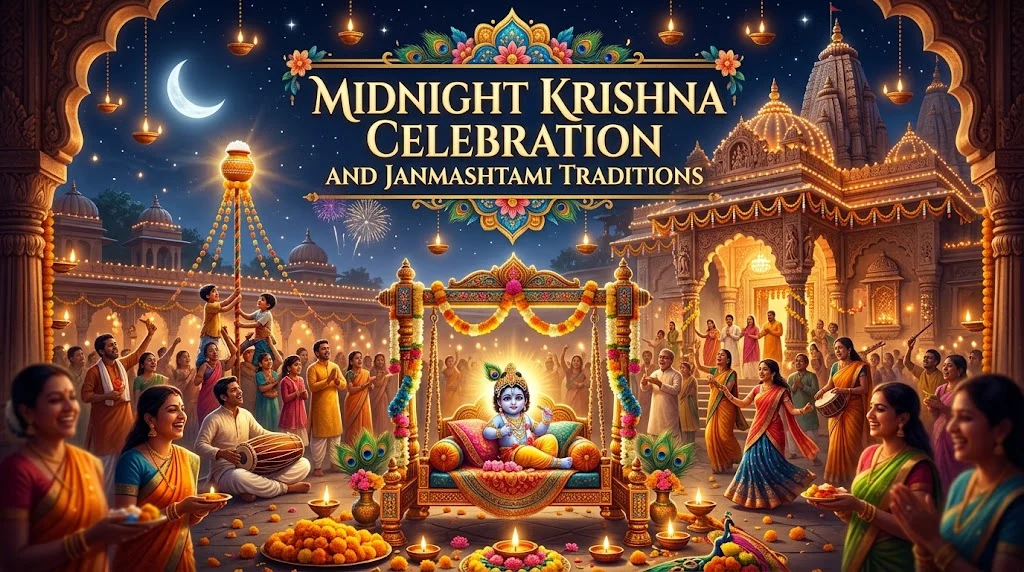
The midnight celebration is often the emotional heart of Janmashtami. Families may spend the evening preparing food, decorating the home, singing bhajans, and listening to stories about Krishna.
As midnight approaches, the atmosphere becomes more focused. Devotees gather around the Krishna idol and perform the birth ceremony. Bells may ring, aarti may be performed, and everyone offers prayers.
In temples, the celebration can be even more elaborate. Crowds gather for darshan, devotional music, decorations, and special rituals.
- Begin preparations early to avoid last-minute stress.
- Decorate the Krishna altar with flowers.
- Keep the puja items ready before evening.
- Play soft devotional music during family gatherings.
- Prepare traditional offerings before the midnight ceremony.
- Invite children to participate in simple rituals.
- Read the story of Krishna’s birth together.
- Perform aarti when the birth celebration begins.
- Share prasad with everyone after worship.
- Keep devotion at the center of the celebration.
Mathura Janmashtami and the Sacred Birthplace Tradition
Mathura holds a special place in Janmashtami celebrations because it is traditionally regarded as Krishna’s birthplace. During the festival, the city becomes a major center of devotion.
Temples and streets can take on a festive atmosphere, with religious programs, decorations, devotional singing, and special ceremonies. The connection between Krishna’s birth story and Mathura makes the city especially meaningful for devotees.
For people who cannot travel, the spirit of Mathura can still be brought into the home through prayer, storytelling, and devotion.
- Mathura is traditionally linked with Krishna’s birth.
- Krishna Janmashtami is deeply important to the city’s religious identity.
- Temples organize special programs during the festival.
- Devotees gather for prayers and darshan.
- Krishna’s birth story is central to the celebrations.
- Religious music adds to the festive atmosphere.
- Families can learn about Mathura’s Krishna traditions.
- Visiting devotees often plan trips around Janmashtami.
- Home celebrations can also honor Mathura’s spiritual importance.
- Mathura reminds devotees of the beginning of Krishna’s earthly story.
Vrindavan and Gokul Janmashtami Celebrations
Vrindavan is closely associated with Krishna’s childhood, devotion, and the Radha Krishna tradition. During Janmashtami, the town becomes a major destination for devotees seeking a deeply devotional experience.
Nearby Gokul is also important because traditional stories describe Krishna’s childhood there with Nanda and Yashoda. The mood of Gokul celebrations often focuses on Bal Krishna and his playful childhood.
These places show how one festival can contain many different emotional layers, from the seriousness of Krishna’s birth to the joy of his childhood.
- Vrindavan is strongly associated with Krishna bhakti.
- Gokul is linked with Krishna’s childhood.
- Radha Krishna devotion is central to many celebrations.
- Temples decorate their spaces for Janmashtami.
- Devotional songs are heard throughout the festival period.
- Krishna’s childhood stories are shared with children.
- Families may watch temple celebrations online.
- Pilgrims often visit important Krishna temples.
- Gokul highlights the loving side of Krishna’s childhood.
- Vrindavan represents a deep culture of devotion.
Dahi Handi 2026 and Maharashtra Celebrations
In Maharashtra, Janmashtami celebrations are famously connected with Dahi Handi. The tradition draws inspiration from stories of young Krishna and his love for butter.
During Dahi Handi events, groups form human pyramids to reach and break a decorated pot. The event creates a strong sense of teamwork and community. While the celebration is energetic and public, it remains connected with the playful image of Krishna.
Dahi Handi is often associated with the day after the main Janmashtami observance. A 2026 Panchang reference lists Dahi Handi on Saturday, September 5, 2026 for its location-based calculation.
- Dahi Handi is especially popular in Maharashtra.
- The tradition recalls Krishna’s playful butter stories.
- Teams work together to form human pyramids.
- Community participation is a major part of the event.
- Music and public celebrations create a festive atmosphere.
- Safety should always be a priority during events.
- Different communities organize Dahi Handi in different ways.
- The tradition combines devotion with teamwork.
- Children often enjoy Krishna-themed activities around the festival.
- Dahi Handi adds a lively cultural dimension to Janmashtami.
Radha Krishna Devotion, Bhajans, and Temple Worship
For many devotees, Janmashtami is closely connected with Radha Krishna devotion. Krishna’s name is often remembered through bhajans, kirtans, aarti, and devotional readings.
Music can make the festival feel intimate and peaceful. A family may spend the evening singing together instead of focusing only on decorations or food. Temples may organize longer devotional programs with singers, priests, and community gatherings.
The most important part is sincerity. Even a simple prayer can create a meaningful moment.
- Radha Krishna devotion has a special place in Krishna bhakti.
- Bhajans help create a devotional atmosphere.
- Kirtan encourages collective worship.
- Aarti is commonly performed during temple and home worship.
- Families can sing simple Krishna bhajans together.
- Children can learn traditional devotional songs.
- Temple worship offers a shared spiritual experience.
- Krishna’s name is remembered through many forms of prayer.
- Music can bring family members together.
- Devotion does not require an elaborate celebration.
Janmashtami Food, Offerings, and Home Decorations
Food is another joyful part of Janmashtami. Families often prepare dishes according to their fasting rules and regional customs. Milk, curd, fruits, makhan, sweets, and other traditional foods may be offered to Krishna.
Home decoration can be simple. A small Krishna cradle, flowers, peacock-feather motifs, lamps, and a clean puja space can create a beautiful setting.
The goal is not to compete with anyone else’s celebration. The best decoration is one that feels peaceful and meaningful to the family.
- Prepare fasting-friendly foods according to family tradition.
- Offer fresh fruits during Krishna Puja.
- Milk-based offerings are common in many homes.
- Makhan is linked with Krishna’s childhood stories.
- Traditional sweets can be included as prasad.
- Decorate the puja area with flowers.
- Create a small cradle for Bal Gopal.
- Use simple lights around the home temple.
- Let children help with safe decorations.
- Share prasad with family members and guests.
Janmashtami Celebration Ideas for Families
Janmashtami can become a wonderful family experience when everyone takes part. Children can dress as Krishna or Radha. Parents can tell the story of Krishna’s birth. Grandparents can share family traditions and devotional memories.
You do not need an expensive event. A simple home gathering can be just as meaningful. What matters is the time spent together and the values discussed during the celebration.
- Dress children as Krishna or Radha for a family activity.
- Create a small Krishna-themed photo corner.
- Read the birth story before midnight.
- Make a simple paper peacock-feather decoration.
- Prepare a child-friendly Krishna quiz.
- Sing a family bhajan together.
- Create a small handmade Krishna cradle.
- Teach children why Janmashtami is celebrated.
- Share stories about kindness and courage.
- End the evening with family prayers and prasad.
Janmashtami Wishes, Quotes, Captions, and Krishna Status Ideas
Janmashtami is also a time to share warm messages with friends and family. A good wish does not need complicated words. A short message about peace, devotion, love, and Krishna’s blessings can feel more personal.
Social media users can also share Janmashtami captions, Krishna quotes, or a simple status message with a festival photograph. Keep the words natural and connected to the meaning of the day.
- May Krishna fill your home with peace and happiness.
- May faith guide you through every difficult moment.
- Let Krishna’s wisdom inspire your choices today.
- May your family celebrate Janmashtami with love and devotion.
- May the spirit of Krishna bring courage to your heart.
- Celebrate the birth of Krishna with faith and gratitude.
- May this Janmashtami bring new hope into your life.
- Let kindness and compassion be your festival gifts.
- May every prayer bring your heart closer to peace.
- Wishing your family a beautiful and meaningful Janmashtami.
Janmashtami 2026 Quotes and Captions for Social Media
A Krishna-themed post can share more than a beautiful photograph. It can express what the festival means to you. Whether you are posting a temple visit, family celebration, Bal Gopal decoration, or midnight puja, choose a caption that matches the moment.
Short captions usually work best because they are easy to read. A thoughtful Krishna quote can also make a post feel more personal.
- Celebrating Krishna with faith, love, and a grateful heart.
- A night of devotion, a lifetime of Krishna’s wisdom.
- Let faith be stronger than fear.
- Krishna’s story reminds us that hope always has a place.
- Finding peace in prayer and joy in devotion.
- Keeping Krishna’s teachings close to the heart.
- A beautiful night dedicated to faith and divine love.
- Celebrating Janmashtami with family, prayer, and gratitude.
- May Krishna’s wisdom guide every new beginning.
- Let this Janmashtami inspire kindness beyond the festival.
Regional Janmashtami Customs Across India
India celebrates Janmashtami in many different ways. The core idea remains the same, but local traditions can be very different.
Some communities focus heavily on temple worship and fasting. Others organize cultural programs, Dahi Handi events, devotional singing, or elaborate home decorations. In some places, children become the center of the celebration through Krishna-themed costumes and activities.
This diversity is one of the festival’s greatest strengths.
- North Indian celebrations often emphasize Krishna’s birth story.
- Mathura has a strong connection with Krishna’s birthplace tradition.
- Vrindavan is known for its deep Krishna devotional culture.
- Gokul is associated with Krishna’s childhood traditions.
- Maharashtra is famous for Dahi Handi celebrations.
- South Indian communities may follow distinct local customs.
- Some families focus more on fasting and midnight puja.
- Others emphasize music, dance, and cultural programs.
- Temple traditions can differ from household traditions.
- Regional diversity makes Indian Janmashtami especially vibrant.
How to Celebrate Krishna Janmashtami 2026 With Meaning
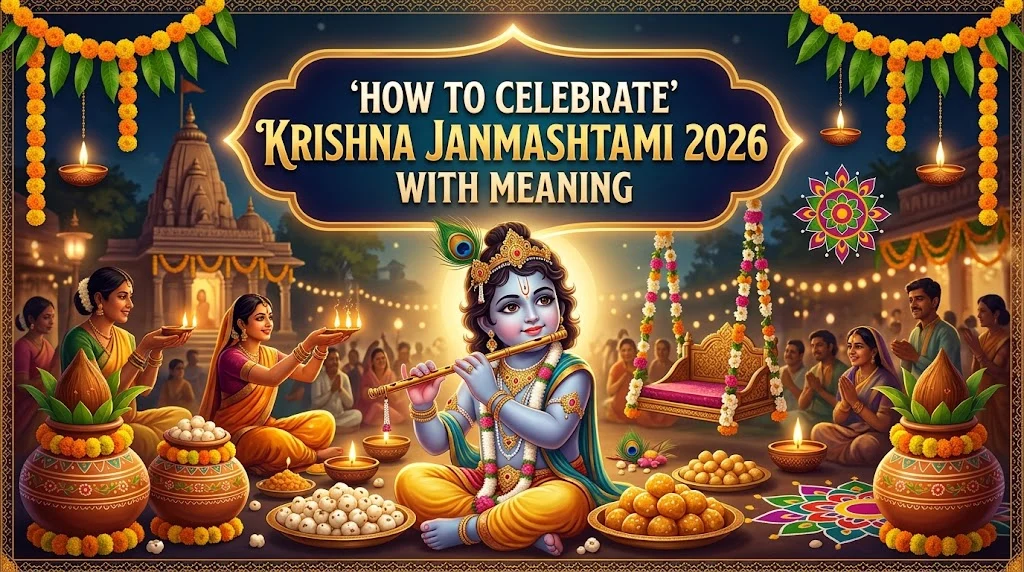
A meaningful Janmashtami does not have to be complicated. You can begin the day with a simple prayer, follow your family’s fasting tradition, decorate a small Krishna altar, and spend time learning about Krishna’s life.
The festival becomes even more meaningful when its values continue after the celebration. Help someone. Speak kindly. Fulfill your responsibilities. Stay calm during difficult situations. These simple actions can bring Krishna’s teachings into everyday life.
- Begin the day with gratitude.
- Follow your family’s traditional worship practice.
- Check the local Panchang for important timings.
- Prepare the puja area before evening.
- Keep fasting practices safe and suitable for your needs.
- Spend time with family instead of rushing through rituals.
- Teach children the meaning behind the celebration.
- Share food and prasad with others.
- Practice kindness as part of the festival.
- Carry Krishna’s message of faith and courage into daily life.
Conclusion
Krishna Janmashtami 2026 is more than a date on the calendar. It is a night of devotion, family, faith, and hope. Janmashtami 2026 Date & Time details help devotees plan their fasting, puja, and midnight worship, but the deeper meaning of the festival goes beyond exact hours.
On Friday, September 4, 2026, devotees across India will remember the birth of Lord Krishna and the timeless values connected with his life. Mathura will remain closely linked with his birth story, while Vrindavan and Gokul will reflect the beauty of his childhood traditions. Maharashtra will bring its own energy through Dahi Handi celebrations.
At home, the celebration can be simple. A Krishna idol, a lamp, a few flowers, a family prayer, and sincere devotion can be enough. Fasting and Parana should follow one’s family or religious tradition, with local Panchang timings checked carefully.
Ultimately, Janmashtami reminds us to choose courage over fear, kindness over anger, and faith over hopelessness. May Krishna’s wisdom bring peace to every home and inspire us to live with love, responsibility, and compassion.
Frequently Asked Questions
When is Krishna Janmashtami in India in 2026?
Krishna Janmashtami will be celebrated in India on Friday, September 4, 2026. The festival is associated with Krishna Paksha Ashtami and the traditional midnight birth celebration of Lord Krishna. The exact puja and Nishita Kaal timing varies by city, so devotees should check a reliable local Panchang.
What is the Nishita Kaal for Janmashtami 2026?
Nishita Kaal is the midnight period traditionally used for Krishna Janmashtami worship. The exact time depends on location. For example, a 2026 Panchang gives 11:57 PM to 12:42 AM for Noida and 11:38 PM to 12:23 AM for Balrampur. Local city timings should always be checked before puja.
Why is Krishna Janmashtami celebrated?
Krishna Janmashtami celebrates the traditional birth of Lord Krishna. Devotees remember his life, teachings, courage, wisdom, compassion, and devotion. The festival also carries a message of hope and righteousness. Through fasting, prayer, bhajans, puja, and midnight worship, families remember the spiritual values associated with Krishna.
How do people celebrate Janmashtami in India?
People celebrate Janmashtami in many ways depending on their region and family tradition. Common practices include fasting, Krishna Puja, Bal Gopal worship, bhajans, aarti, midnight celebrations, temple visits, decorations, and prasad. Mathura, Vrindavan, and Gokul have special Krishna traditions, while Maharashtra is particularly known for Dahi Handi.
What are the best Janmashtami wishes and captions for 2026?
The best Janmashtami wishes are simple, warm, and meaningful. Messages about Krishna’s blessings, peace, faith, love, courage, and happiness work well for family and friends. For social media, short Krishna captions can be paired with photos of temple visits, Bal Gopal decorations, family celebrations, or the midnight puja.