
India’s Independence Day is celebrated every year on 15 August to remember the country’s freedom from British rule. As 15 August 2026 approaches, one question is especially common: Is Independence Day 2026 the 79th or 80th? The answer depends on whether we are talking about the anniversary of independence or the numbered Independence Day celebration.
India became independent on 15 August 1947. Therefore, 15 August 2026 marks 79 years since independence. At the same time, it is India’s 80th Independence Day celebration because 15 August 1947 was the first Independence Day. This distinction can seem confusing, but it becomes simple when the years are counted carefully.
Is Independence Day 2026 the 79th or 80th?
The most accurate explanation is that 15 August 2026 is the 80th Independence Day, while it marks the 79th anniversary of India’s independence.
India gained independence on 15 August 1947. Counting the completed years from 1947 to 2026 gives 79 years.
The calculation is:
2026 − 1947 = 79
However, when Independence Day celebrations are counted from the first celebration in 1947, the calculation includes 1947 as the first Independence Day:
1947 = 1st Independence Day 1948 = 2nd Independence Day 1949 = 3rd Independence Day … 2025 = 79th Independence Day 2026 = 80th Independence Day
Therefore, both numbers can appear in discussions, but they describe two slightly different things.
The phrase “79th anniversary of independence” refers to the number of years India has been independent. “80th Independence Day” refers to the number of Independence Day celebrations since the first celebration in 1947.
For general Independence Day content, 80th Independence Day is the appropriate description for 15 August 2026.
When Did India Gain Independence?
India became independent from British rule on 15 August 1947. The event marked the end of British colonial rule after a long freedom movement involving countless individuals and organizations.
The independence movement developed over many decades. People across different regions and communities participated in protests, political campaigns, social movements, boycotts, and other forms of resistance.
The struggle for freedom involved well-known leaders as well as millions of ordinary people. Their efforts, sacrifices, imprisonment, determination, and commitment contributed to the eventual achievement of independence.
On the night of 14 August and into 15 August 1947, the historic transfer of power took place. Jawaharlal Nehru, who became independent India’s first Prime Minister, delivered his famous “Tryst with Destiny” speech before the Constituent Assembly.
On the morning of 15 August, the national celebration of independence began. The day became a lasting symbol of freedom and national self-determination.
Why Is 15 August Celebrated as Independence Day?
15 August is celebrated because it represents the day India became independent from British rule.
For Indians, the date carries historical, emotional, and national significance. It reminds people of the long struggle that preceded independence and the sacrifices made by countless freedom fighters.
Independence Day is not simply a historical anniversary. It is also an opportunity to think about the responsibilities that come with freedom.
Every year, schools, colleges, government institutions, communities, and families observe the day through ceremonies, cultural programs, speeches, patriotic activities, and flag-hoisting events.
The celebration also encourages citizens to think about national unity, peace, development, equality, responsibility, and the future of the country.
15 August 1947: A Historic Day in India
15 August 1947 changed the course of Indian history.
After nearly two centuries of British colonial rule, India became an independent nation. The occasion represented the achievement of a long-standing national aspiration.
The transition to independence was accompanied by the Partition of British India, which created the independent dominions of India and Pakistan. Partition led to enormous human suffering, displacement, and communal violence.
This difficult historical context is an important part of understanding independence. The freedom celebrated on 15 August came during a period of tremendous political and social change.
Despite the challenges surrounding independence, the day represented a new beginning. India faced the enormous task of building a democratic nation while addressing poverty, social inequality, displacement, and other challenges.
The significance of 15 August therefore extends beyond celebration. It represents both the achievement of freedom and the beginning of the responsibility to build the nation.
The Difference Between 79 Years and the 80th Independence Day
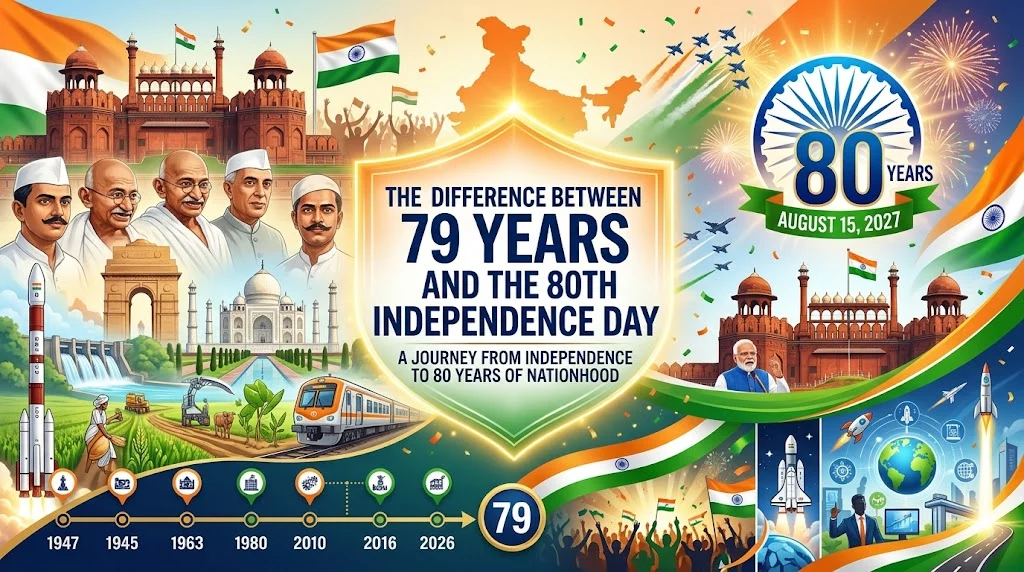
The difference becomes clear when we distinguish between an anniversary and an event number.
An anniversary counts completed years.
An event number counts occurrences.
For example, if a person is born in 2000, their first birthday is celebrated in 2001. Their 25th birthday occurs in 2025, when they have completed 25 years.
A similar principle applies to Independence Day.
India became independent on 15 August 1947. The celebration held that year was the first Independence Day. After 79 completed years, the celebration in 2026 becomes the 80th Independence Day.
That is why describing 2026 as both the “79th anniversary of independence” and the “80th Independence Day” is not contradictory.
The two expressions simply measure different things.
India’s 80th Independence Day in 2026
On 15 August 2026, India will observe its 80th Independence Day.
The occasion will provide another opportunity to remember the country’s freedom struggle and honor the people who contributed to India’s independence.
The national celebration traditionally includes the Prime Minister’s address from the Red Fort in New Delhi, where the national flag is hoisted. Ceremonies and cultural programs are also held across the country.
Schools and educational institutions commonly organize flag-hoisting ceremonies, patriotic speeches, cultural performances, essay competitions, debates, and other activities.
Families and communities also mark the occasion by sharing Independence Day messages, greetings, quotes, and patriotic thoughts.
For many people, the day is an opportunity to express gratitude for the sacrifices of previous generations and hope for a peaceful and prosperous future.
Important Facts About India’s Independence Day
Several historical facts help explain why 15 August remains one of India’s most important national days.
India became independent on 15 August 1947 after the end of British colonial rule.
Jawaharlal Nehru became the first Prime Minister of independent India.
Nehru delivered the famous “Tryst with Destiny” speech shortly before India became independent.
The first Independence Day was celebrated on 15 August 1947.
India’s national flag became a central symbol of the independence celebrations.
The Red Fort in New Delhi became closely associated with the annual Independence Day ceremony.
The Prime Minister traditionally addresses the nation from the Red Fort on Independence Day.
The day honors the sacrifices and contributions of the freedom movement.
Independence Day is a national holiday in India.
In 2026, India will celebrate its 80th Independence Day and mark 79 completed years of independence.
These facts help resolve the common question about whether the 2026 celebration should be called the 79th or 80th.
Who Were the Major Figures in India’s Freedom Movement?
India’s independence was the result of contributions from numerous leaders, activists, reformers, revolutionaries, workers, students, writers, and ordinary citizens.
Mahatma Gandhi played a major role in India’s freedom movement through his philosophy of nonviolent resistance and mass political mobilization.
Jawaharlal Nehru became an important leader of the Indian National Congress and later served as independent India’s first Prime Minister.
Subhas Chandra Bose became known for his leadership of the Indian National Army and his determined opposition to British rule.
Sardar Vallabhbhai Patel played an important role in the independence movement and later in integrating the princely states into the Indian Union.
Bhagat Singh became a powerful symbol of revolutionary resistance and sacrifice.
Other important figures included Sarojini Naidu, Bal Gangadhar Tilak, Lala Lajpat Rai, Bipin Chandra Pal, Maulana Abul Kalam Azad, Annie Besant, Chandra Shekhar Azad, and many others.
The freedom movement cannot be reduced to the work of only a few famous individuals. Millions of people contributed in different ways.
Why Is Independence Day Important for Young People?
Independence Day provides young people with an opportunity to learn about India’s history and understand the value of freedom.
Students can explore the struggles faced by previous generations and learn how political movements shaped modern India.
The day can also encourage young citizens to think about their responsibilities toward society. Freedom provides opportunities, but it also requires responsible participation.
Young people can contribute to the country’s future through education, honesty, creativity, respect, innovation, community service, and responsible citizenship.
Independence Day activities in schools often help students connect historical events with modern national life.
Patriotic speeches, essays, debates, quizzes, cultural programs, and flag-hoisting ceremonies can make the history of independence more meaningful and memorable.
The day reminds students that the future of the nation depends partly on the choices and actions of the next generation.
How Is Independence Day Celebrated in India?
Independence Day is celebrated across India in many different ways.
The national flag is hoisted at government offices, schools, colleges, and other institutions. Patriotic songs and cultural programs are often part of local celebrations.
The main national ceremony takes place in New Delhi, where the Prime Minister hoists the national flag at the Red Fort and addresses the nation.
Across different states and cities, people organize cultural events, public programs, educational activities, and community gatherings.
Many families spend time together and discuss the meaning of independence. People also share patriotic messages through social media, messaging platforms, and other communication channels.
Independence Day greetings often focus on freedom, peace, unity, courage, national pride, and hope.
The celebration can therefore be both public and personal. While large national ceremonies attract attention, simple family and community observances also keep the spirit of the day alive.
Independence Day and the Meaning of Freedom
Freedom is one of the central ideas associated with 15 August.
Political independence gave India the opportunity to determine its own future rather than remain under colonial rule.
Freedom also comes with responsibility. A free society depends on citizens who respect laws, value other people, participate constructively, and work toward peaceful coexistence.
Independence Day encourages people to think about what freedom means in everyday life.
It is a time to remember that national independence was not achieved without sacrifice. The freedom enjoyed today was shaped by decades of political struggle and the efforts of people who faced imprisonment, hardship, violence, and personal loss.
Remembering this history helps citizens appreciate the importance of peace and national unity.
15 August Independence Day Wishes and Messages
Independence Day is also a popular occasion for sending meaningful greetings to friends, relatives, classmates, colleagues, and loved ones.
A good Independence Day message does not need to be complicated. A simple expression of gratitude, patriotism, peace, or hope can carry strong meaning.
People often share wishes such as:
Happy Independence Day to every proud Indian.
May the spirit of freedom inspire us to create a better future.
Let us remember the sacrifices of our freedom fighters with gratitude.
May our nation continue to progress through unity and peace.
Wishing everyone a meaningful and memorable Independence Day.
Let us celebrate freedom while remembering the responsibility that comes with it.
May India’s future be filled with peace, opportunity, and prosperity.
Let us honor our history and work together for a stronger tomorrow.
These messages can be used in greeting cards, WhatsApp statuses, social media posts, school programs, or personal messages.
Independence Day Quotes and Patriotic Thoughts
Patriotic quotes are another popular way to express feelings on 15 August.
A meaningful quote can highlight freedom, courage, unity, sacrifice, or national pride. It can also encourage people to reflect on the responsibilities of citizenship.
Some simple thoughts for Independence Day include:
Freedom is a precious legacy that every generation must value.
A strong nation begins with responsible and caring citizens.
Patriotism becomes meaningful when it inspires positive action.
Unity gives a nation strength during difficult times.
Remembering history helps us understand the value of freedom.
Peace is essential for a nation’s lasting progress.
The sacrifices of the past should inspire hope for the future.
A proud citizen respects both the nation and its people.
Independence Day reminds us that freedom should never be taken for granted.
The best tribute to freedom fighters is to build a better society.
These thoughts can be adapted for speeches, school assignments, greeting cards, and social media posts.
Is Independence Day 2026 79th Or 80th? History, Facts …
The question “Is Independence Day 2026 79th Or 80th? History, Facts …” can be answered clearly by understanding the difference between completed years and celebration numbers.
India became independent on 15 August 1947. By 15 August 2026, 79 complete years will have passed since independence.
However, 15 August 1947 was the first Independence Day celebration. Therefore, the celebration in 2026 will be the 80th Independence Day.
So the simplest answer is:
15 August 2026 is India’s 80th Independence Day and the 79th anniversary of independence.
Both statements are correct when used in their proper context.
This distinction is especially useful for students, writers, teachers, bloggers, and anyone preparing Independence Day content. Using the correct terminology makes historical information clearer and prevents unnecessary confusion.
How to Explain the 2026 Independence Day Correctly
If someone asks whether India will celebrate its 79th or 80th Independence Day in 2026, the best response is straightforward.
India will celebrate its 80th Independence Day on 15 August 2026.
The same date will mark 79 years since India gained independence in 1947.
The reason for the difference is that the first Independence Day was celebrated on 15 August 1947. Thus, the number of celebrations is one higher than the number of completed years after the original event.
This distinction is common when counting anniversaries and annual events. The 80th Independence Day does not mean India became independent 80 years ago. It means the country is celebrating Independence Day for the 80th time.
The historical date remains 15 August 1947, and the 2026 date represents 79 completed years since that historic event.
Conclusion
15 August remains one of the most important dates in India’s history. It reminds the nation of the long struggle for freedom, the sacrifices of countless people, and the responsibilities that come with independence. In 2026, India will celebrate its 80th Independence Day while marking 79 completed years since gaining independence in 1947.
Understanding this distinction removes the confusion surrounding the anniversary and celebration numbers. The occasion is also a time to promote patriotism, unity, peace, gratitude, and national pride.
Whether people observe the day through ceremonies, family gatherings, school programs, or Independence Day greetings, the central message remains the same: freedom should be valued and protected. The question “Is Independence Day 2026 79th Or 80th? History, Facts …” therefore has a clear answer: it is the 80th Independence Day and the 79th anniversary of independence.
FAQs
What is the best message for 15 August Independence Day?
A meaningful Independence Day message can express gratitude for freedom, respect for freedom fighters, and hope for the country’s future. A simple message such as “May the spirit of freedom inspire us to build a peaceful, united, and prosperous nation” is suitable for friends, family, colleagues, and social media.
How can I wish someone a Happy Independence Day?
You can wish someone by sending a short and heartfelt patriotic message. For example, you can write, “Wishing you a proud and peaceful Independence Day. May our nation continue to grow through unity, courage, and hope.” Personalizing the message for friends or family can make the greeting more meaningful.
What are some short Independence Day wishes?
Short wishes can include “Happy Independence Day,” “Proud to be Indian,” “May freedom always inspire us,” or “Wishing India peace and progress.” These simple messages work well for WhatsApp status updates, text messages, greeting cards, and social media posts.
What can I post on Instagram for Independence Day?
You can post a patriotic photograph, national celebration image, historical reflection, or personal message about freedom. A short caption about national pride, unity, gratitude, or the sacrifices of freedom fighters can make an appropriate Independence Day post. Keep the message respectful and connected to the meaning of 15 August.
Why is Independence Day important?
Independence Day is important because it commemorates India’s freedom from British rule on 15 August 1947. It honors the sacrifices made during the freedom movement and reminds citizens about the value of independence. It also encourages national unity, responsible citizenship, peace, gratitude, and hope for India’s future.