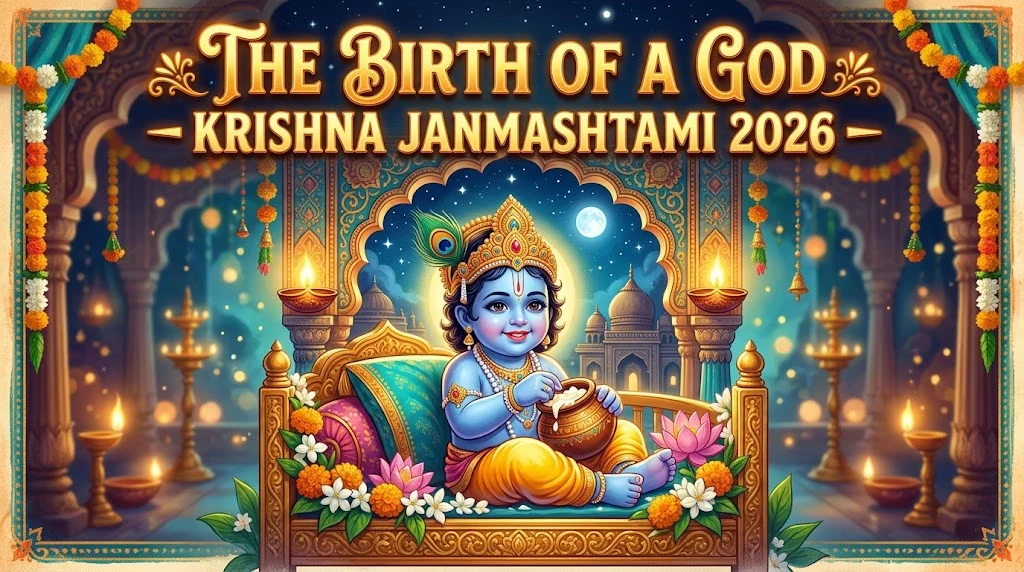
There is something special about a festival that makes an entire home feel different. On Krishna Janmashtami, homes across India become brighter with flowers, lamps, devotional songs, and the joyful presence of Bal Gopal. Families remember the divine birth of Lord Krishna, a figure deeply connected with devotion, wisdom, love, courage, and faith. In 2026, Krishna Janmashtami will be observed on Friday, September 4, in India. The celebration brings together spirituality and family happiness in a beautiful way. From midnight prayers to temple visits, fasting, bhajans, Krishna decorations, and traditional offerings, every custom carries a meaning. The Birth of a God – Krishna Janmashtami 2026 is not only about remembering Krishna’s arrival in Mathura. It is also about finding hope in difficult times and choosing goodness, compassion, courage, and positive action in everyday life.
Krishna Janmashtami 2026 Date in India and What the Tithi Means
For most Indian Panchang calculations, Krishna Janmashtami 2026 falls on Friday, September 4, 2026. The festival is observed on Krishna Paksha Ashtami, the eighth lunar day of the dark fortnight in the month traditionally associated with Krishna’s birth.
The exact religious calendar can look slightly different from a normal calendar because Hindu festivals are calculated using lunar tithis and local astronomical conditions. This is why the date and timing are best understood through a city-specific Panchang.
For 2026, the cited Panchang calculations show Ashtami Tithi beginning around 2:25 AM on September 4 and ending around 12:13 AM on September 5, although local calculations can differ slightly.
If you are planning a fast or puja, check the Panchang for your own city rather than copying a time from another location.
- Krishna Janmashtami 2026 will be observed on Friday, September 4.
- The festival is connected with Krishna Paksha Ashtami.
- Ashtami is the eighth lunar day of the dark fortnight.
- The tithi is important when determining the festival date.
- Hindu festival dates follow lunar calculations.
- Local sunrise and sunset can affect observance times.
- Different Indian cities may show slightly different timings.
- Families should follow their traditional Panchang where appropriate.
- Temple schedules may differ from household schedules.
- The date is only one part of the Janmashtami observance.
Ashtami Tithi, Rohini Nakshatra and Nishita Kaal in 2026
Many devotees search for Janmashtami date and time because the festival is closely linked with the moment of Krishna’s birth. Traditional accounts associate Krishna’s birth with the eighth day of the dark fortnight and Rohini Nakshatra.
For 2026, the cited Panchang data places the beginning of Rohini Nakshatra around 12:29 AM on September 4, with the end around 11:04 PM on September 4 in several northern Indian calculations.
The most important worship period is Nishita Kaal, the Hindu midnight period. However, it is not identical across India. For example, one calculation for New Delhi gives a Nishita Puja window of about 11:57 PM to 12:43 AM, while other cities show different windows.
This difference is normal. Panchang timings depend on geography. Always check your city before following a fasting or puja schedule.
- Ashtami Tithi is central to Janmashtami observance.
- Rohini Nakshatra has a special place in Krishna traditions.
- Nishita Kaal refers to the sacred midnight worship period.
- The midnight window changes from city to city.
- New Delhi has its own local Nishita calculation.
- Mumbai may have a later local midnight window.
- Kolkata can have an earlier Nishita period.
- Local Panchang timings are better than generic online timings.
- Devotees should check the date and time together.
- Religious observance should respect family and regional traditions.
The Birth of Krishna: A Story of Hope and Courage
The traditional story of Krishna’s birth begins in Mathura, where Devaki and Vasudeva were imprisoned by the cruel ruler Kamsa. A prophecy had warned Kamsa that Devaki’s eighth child would become the cause of his downfall.
Fear controlled Kamsa. He tried to prevent the prophecy by harming Devaki’s children. Yet the story moves toward hope rather than fear.
When Krishna was born, Vasudeva carried the newborn child away from Mathura. He crossed the Yamuna and reached Gokul, where Nanda and Yashoda welcomed the child into their home. Krishna’s childhood then became closely associated with Gokul and later Vrindavan.
For devotees, this story represents more than a miraculous event. It shows that darkness does not last forever. Courage can rise during difficult times, and faith can give people the strength to continue.
- Devaki is remembered as Krishna’s birth mother.
- Vasudeva protected the newborn Krishna.
- Kamsa represents fear and misuse of power.
- Mathura is traditionally associated with Krishna’s birth.
- Gokul is linked with Krishna’s childhood.
- Nanda and Yashoda raised Krishna with loving care.
- The Yamuna is an important part of the birth story.
- Krishna’s birth represents hope during darkness.
- The story connects courage with divine purpose.
- Janmashtami keeps this timeless story alive for new generations.
Why Krishna Janmashtami Is Spiritually Important
Janmashtami is deeply spiritual because Krishna is remembered not only as a divine figure but also as a teacher, guide, friend, child, and protector.
His life is connected with ideas such as dharma, devotion, courage, wisdom, compassion, and duty. The Bhagavad Gita, traditionally presented as Krishna’s dialogue with Arjuna, places strong emphasis on responsible action, inner balance, and performing one’s duty with sincerity.
This makes Janmashtami meaningful even beyond temple celebrations. A family may celebrate the festival at home and still use it as a moment for reflection.
The festival encourages people to think about how they treat others, how they respond to difficulties, and whether their actions bring goodness into the world.
- Krishna teaches the value of doing one’s duty.
- Devotion encourages a sincere heart.
- Courage helps people face difficult situations.
- Wisdom can guide action during confusion.
- Compassion makes spiritual practice more meaningful.
- Self-control can strengthen personal discipline.
- Faith can provide comfort during uncertainty.
- Dharma reminds people to choose responsible action.
- Love connects Krishna devotion with everyday life.
- Positive action turns spiritual ideas into real behavior.
Janmashtami Fasting Traditions and Parana Time
Fasting is an important part of Janmashtami for many devotees. However, there is no single fasting method followed by every family. Some devotees observe a strict fast, while others choose fruits, milk, permitted foods, or a simpler form of fasting.
The purpose is generally to create a focused and devotional state of mind. The fast is often maintained through the day and connected with the midnight birth celebration.
Parana means breaking the fast. Its timing can depend on the religious tradition being followed. In the cited 2026 Panchang calculations, Dharma Shastra-based Parana can be after sunrise on September 5 when the relevant tithi and nakshatra have ended, while some modern practices break the fast after Nishita.
Because these rules vary, follow the tradition of your family or temple.
- Fasting is a devotional practice, not merely a food restriction.
- Different families follow different fasting methods.
- Fruit-based fasting is common in many households.
- Some devotees include milk in their fast.
- Health and age should be considered before fasting.
- Children do not need to follow adult fasting rules.
- Parana means breaking the Janmashtami fast.
- Parana timing can depend on the chosen tradition.
- Local Panchang guidance can clarify the correct timing.
- Devotion and sincerity remain more important than appearance.
Krishna Puja and Midnight Birth Celebration
The heart of Janmashtami often arrives at midnight. Families prepare a clean and peaceful puja space for Krishna. A small idol of Bal Gopal may be placed in a decorated cradle.
Devotees offer flowers, fruits, sweets, milk-based preparations, and other traditional foods. Bhajans and aarti may continue before and after the midnight moment.
At Nishita Kaal, many devotees symbolically welcome Krishna’s birth. Some gently rock the cradle. Others sing devotional songs or offer prayers for family peace and happiness.
The exact puja sequence differs among households and temples. The beauty of the celebration lies in its personal nature.
- Clean the puja space before the celebration begins.
- Decorate Bal Gopal with simple traditional items.
- Prepare offerings according to family custom.
- Keep flowers ready for the midnight puja.
- Include devotional bhajans during the evening.
- Perform aarti with family members.
- Welcome Krishna’s birth with a peaceful heart.
- Keep children involved in simple devotional activities.
- Follow your temple’s preferred puja method when visiting.
- Check the local Nishita Kaal before midnight worship.
Mathura Janmashtami and the Sacred Birthplace Tradition
Mathura holds a special place in Janmashtami celebrations because it is traditionally regarded as Krishna’s birthplace. During the festival season, the city becomes a major center of devotional activity.
Temples and public spaces are decorated, devotional programs are organized, and pilgrims gather to experience the atmosphere associated with Krishna’s birth.
For many devotees, visiting Mathura is not simply a sightseeing trip. It is a spiritual journey connected with the story they have heard since childhood.
The atmosphere can be especially powerful around midnight, when devotees gather for prayers and celebrations connected with Krishna’s birth.
- Mathura is traditionally associated with Krishna’s birth.
- Janmashtami brings special devotional energy to the city.
- Temples prepare elaborate decorations for devotees.
- Pilgrims visit Mathura from many parts of India.
- Midnight prayers are central to the celebration.
- Krishna’s birth story is closely linked with Mathura.
- Temple rituals may continue late into the night.
- Devotional singing adds to the festival atmosphere.
- Families can learn the birth story while visiting.
- Mathura remains one of India’s key Krishna pilgrimage destinations.
Vrindavan Janmashtami and the Joy of Krishna Bhakti
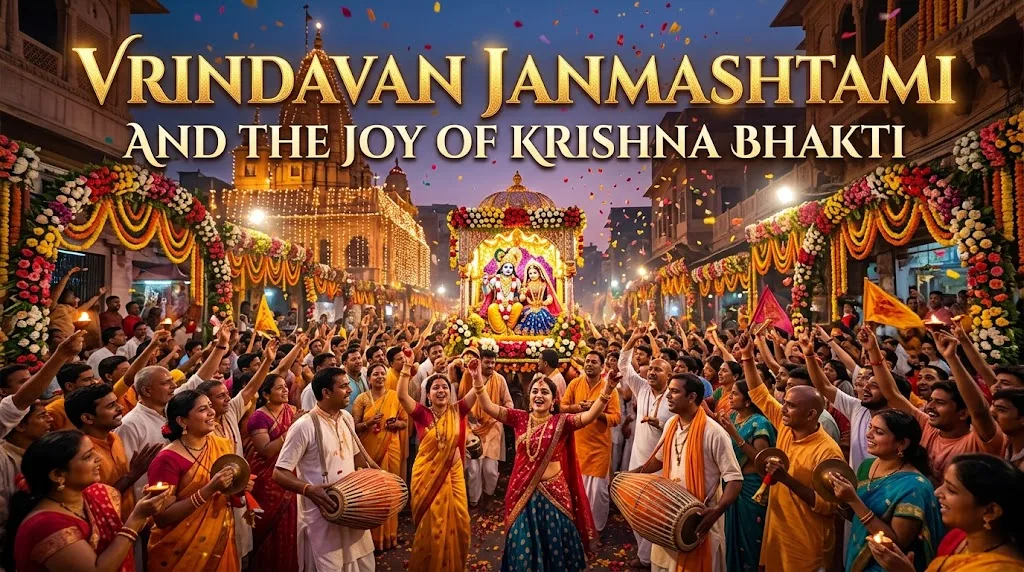
Vrindavan is closely connected with Krishna’s childhood and youthful pastimes in Hindu devotional tradition. Its relationship with Krishna is therefore different from Mathura’s association with his birth.
During Janmashtami, temples and streets in Vrindavan become filled with devotional activity. Visitors may hear bhajans, see beautifully decorated shrines, and join prayer gatherings.
The spirit of Vrindavan is strongly connected with Radha Krishna devotion. Love, surrender, music, and remembrance are important parts of this devotional tradition.
A visit can be meaningful, but devotees can also bring the same spirit into their homes through prayer, music, and loving family participation.
- Vrindavan is strongly connected with Krishna’s childhood traditions.
- Radha Krishna devotion is central to Vrindavan culture.
- Temples create special Janmashtami decorations.
- Devotional music fills many celebration spaces.
- Visitors often join evening prayer programs.
- Krishna bhakti can be expressed through simple worship.
- Family prayer can bring the Vrindavan spirit home.
- Children can learn about Krishna through stories.
- Devotional singing creates a peaceful festival atmosphere.
- Vrindavan represents love-centered Krishna devotion for many devotees.
Gokul Janmashtami and Krishna’s Childhood Traditions
After Krishna’s birth in Mathura, the traditional story connects his childhood with Gokul, where Nanda and Yashoda cared for him.
Gokul is remembered for the playful side of Krishna’s childhood. Stories of butter, cows, friends, and family life give Janmashtami a warm and joyful character.
This is one reason children often enjoy Krishna celebrations. The festival allows parents to introduce spiritual ideas through stories rather than difficult explanations.
A small Krishna costume, a decorated cradle, a story session, or a simple home activity can make the festival memorable for children.
- Gokul is associated with Krishna’s childhood.
- Nanda and Yashoda are central to these traditions.
- Childhood Krishna stories are popular with families.
- Butter is a familiar symbol in Krishna stories.
- Cows are closely connected with Krishna’s childhood imagery.
- Children can learn through simple Krishna stories.
- A small Krishna costume can make celebrations interactive.
- Families can decorate a cradle for Bal Gopal.
- Storytelling can teach kindness and courage.
- Gokul traditions bring a playful side to Janmashtami.
Dahi Handi 2026 and Maharashtra Janmashtami Traditions
Dahi Handi is one of the most energetic Janmashtami traditions, especially in Maharashtra. It draws inspiration from stories of Krishna and his friends enjoying butter and curd.
Groups form human pyramids to reach and break a decorated pot placed above them. The event has become a major public celebration, combining devotion, teamwork, music, and community participation.
For 2026, city-specific Panchang sources list Saturday, September 5 as Dahi Handi day following Janmashtami on September 4.
The style of celebration can vary from one place to another. Public events may also have their own schedules and safety arrangements.
- Dahi Handi is strongly associated with Maharashtra.
- The tradition recalls Krishna’s playful butter stories.
- Human pyramids require teamwork and coordination.
- Public Dahi Handi events attract large crowds.
- Music adds energy to many celebrations.
- Community participation is central to the tradition.
- Safety should remain a priority at public events.
- Dahi Handi is usually celebrated after Janmashtami.
- Families can enjoy the tradition through local events.
- The 2026 Dahi Handi observance is associated with September 5.
Janmashtami Traditions Across Different Parts of India
India does not celebrate Janmashtami in exactly the same way everywhere. The central devotion remains connected with Krishna, but customs, foods, fasting practices, temple rituals, music, and public celebrations can differ.
Some families focus on midnight puja. Others visit temples. Some communities organize dramatic performances or devotional singing. In Maharashtra, Dahi Handi creates a strong public and community atmosphere.
In northern India, Mathura, Vrindavan, and Gokul remain major centers of Krishna devotion. Other regions may have their own local traditions and temple customs.
This variety is part of India’s cultural richness.
- Indian Janmashtami traditions differ by region.
- Families may follow their own inherited customs.
- Temple celebrations can be more elaborate than home rituals.
- Devotional singing is common in many communities.
- Food offerings vary across different regions.
- Fasting practices can differ between families.
- Dahi Handi is especially prominent in Maharashtra.
- Mathura and Vrindavan attract many devotees.
- Local temples often create unique programs.
- Regional diversity makes Janmashtami culturally rich.
Janmashtami Decorations, Food and Family Celebration Ideas
A meaningful Janmashtami celebration does not have to be expensive. A small corner of the home can become a beautiful Krishna shrine with flowers, fabric, lamps, and a decorated cradle.
Families can prepare traditional offerings and involve children in safe, simple activities. Making footprints leading toward the Krishna altar is a popular creative idea in many homes.
Food also becomes part of the celebration. Depending on family tradition, devotees may prepare milk-based dishes, fruits, sweets, makhana preparations, or other fasting-friendly foods.
The most important thing is to create a peaceful environment where everyone can participate.
- Create a simple Krishna corner at home.
- Decorate the cradle with flowers and clean fabric.
- Make small Krishna footprints near the puja space.
- Prepare traditional offerings according to family custom.
- Let children help with safe decorations.
- Play Krishna bhajans during the evening.
- Read a short Krishna birth story together.
- Make a family prayer before midnight.
- Take family photographs after the celebration.
- Keep the decoration peaceful rather than overly complicated.
Janmashtami Wishes, Krishna Quotes and Devotional Messages
Janmashtami wishes are a simple way to share the spirit of the festival with family and friends. A good message does not need difficult language.
The best wishes focus on peace, love, faith, courage, wisdom, and happiness. They can be sent through WhatsApp, social media, greeting cards, or personal messages.
Krishna-inspired messages are especially meaningful when they connect the festival with everyday life. Instead of simply saying Happy Janmashtami, you can wish someone strength during difficult times or peace in their family.
- May Krishna fill your home with peace and devotion.
- May faith guide you through every difficult moment.
- May Krishna bless your family with love and happiness.
- May wisdom help you choose the right path.
- May your Janmashtami be filled with peaceful prayers.
- May the spirit of Krishna bring courage to your heart.
- May your home always have room for kindness.
- May devotion make every new beginning brighter.
- May Krishna’s blessings bring harmony to your family.
- May this Janmashtami inspire a life of goodness.
Janmashtami Captions and Krishna Status Ideas for 2026
Social media gives families another way to share their celebrations. A Krishna photo, temple visit, decorated cradle, Dahi Handi event, or family picture can be paired with a short caption.
The best Janmashtami captions are simple. They express devotion without sounding forced. A short Krishna status can also carry a meaningful thought about faith or love.
You can use different captions for different moments. A temple photograph may need a devotional line, while a family photograph may work better with a warm message.
- Celebrating Krishna with faith in the heart.
- A night of devotion, joy, and divine remembrance.
- Welcoming Bal Gopal with love and prayer.
- Krishna’s story reminds us to choose courage.
- Janmashtami brings faith closer to family life.
- Midnight prayers make this celebration deeply special.
- A little Krishna, a lot of love.
- Keeping the spirit of Krishna alive through devotion.
- Celebrating the divine birth with a grateful heart.
- Janmashtami 2026 is a beautiful reminder to choose goodness.
Simple Janmashtami Celebration Ideas for Families and Children
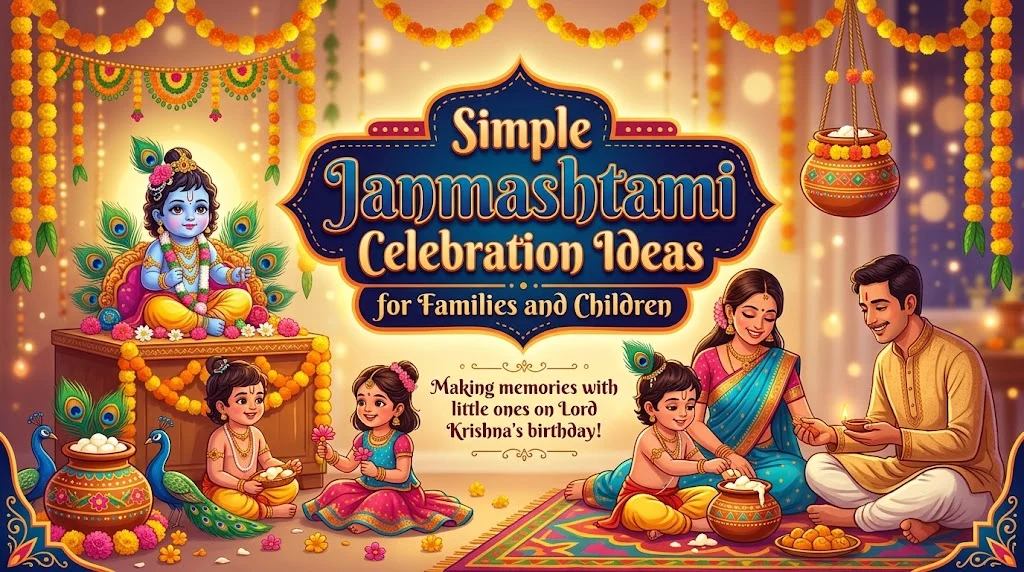
Children can enjoy Janmashtami without needing to understand every religious detail. Parents can explain the story in simple words and allow children to participate in small activities.
A family can read the Krishna birth story, decorate a small cradle, make a paper peacock feather craft, listen to bhajans, or prepare a simple offering together.
These activities turn the festival into a shared family memory. They also help children understand values such as kindness, courage, love, and respect.
The goal is not to make the celebration complicated. A peaceful family evening can be just as meaningful as a large event.
- Tell children the Krishna birth story before bedtime.
- Let children help decorate the puja area.
- Make a simple handmade Krishna craft.
- Create a small flower decoration together.
- Teach children a short devotional song.
- Explain why midnight is important in Janmashtami tradition.
- Let children place flowers near the Krishna idol.
- Prepare a family meal after Parana.
- Encourage children to share sweets respectfully.
- End the celebration with a family prayer.
Conclusion
The Birth of a God – Krishna Janmashtami 2026 is a celebration that brings together faith, family, culture, and devotion. In India, Krishna Janmashtami will be observed on September 4, 2026, with the main worship connected with the sacred midnight period. Exact Nishita Kaal, fasting, and Parana timings should be checked through a trusted city-specific Panchang because local calculations can vary.
The story of Krishna’s birth in Mathura continues to inspire people with its message of hope and courage. Mathura remembers his birth, Vrindavan celebrates his loving devotional traditions, and Gokul keeps alive the joy of his childhood stories. Maharashtra adds its energetic Dahi Handi tradition, while families across India create their own meaningful ways to celebrate.
Whether you observe a fast, perform Krishna Puja, sing bhajans, visit a temple, decorate your home, or simply spend time with loved ones, the heart of Janmashtami remains the same. It is a reminder to choose kindness, faith, courage, love, and positive action. May this Janmashtami bring peace to your home and leave a little more goodness in your heart.
Frequently Asked Questions
When is Krishna Janmashtami in India in 2026?
Krishna Janmashtami will be observed on Friday, September 4, 2026, according to the cited Indian Panchang calculations. The celebration is associated with Krishna Paksha Ashtami. Since religious timings depend on local geography, devotees should check a city-specific Panchang for the exact tithi, Nishita Kaal, fasting, and Parana details.
What is the Nishita Kaal for Janmashtami 2026?
Nishita Kaal is the Hindu midnight period associated with Krishna’s birth worship. There is no single nationwide clock time because the calculation changes by location. For example, the cited Panchang gives approximately 11:57 PM to 12:43 AM for New Delhi, while other Indian cities have different windows.
Why is Krishna Janmashtami celebrated?
Krishna Janmashtami celebrates the traditional birth of Lord Krishna, who is revered as an avatar of Vishnu in Hindu tradition. The festival carries spiritual themes of faith, dharma, courage, devotion, wisdom, and hope. Devotees remember Krishna’s birth through fasting, prayer, bhajans, Krishna Puja, temple visits, and midnight celebrations.
How do people celebrate Janmashtami in India?
People celebrate Janmashtami in many different ways. Common practices include fasting, decorating Krishna idols, preparing offerings, singing bhajans, performing aarti, visiting temples, and observing midnight worship. Mathura, Vrindavan, and Gokul are major devotional centers, while Maharashtra is especially known for Dahi Handi. Regional and family customs can vary.
What are the best Janmashtami wishes and captions for 2026?
The best Janmashtami wishes are simple, warm, and meaningful. Messages about faith, peace, love, courage, family happiness, and Krishna’s blessings work well for WhatsApp and social media. For captions, short devotional lines are usually more natural than complicated phrases. A personal message connected with your celebration can make the post even more special.