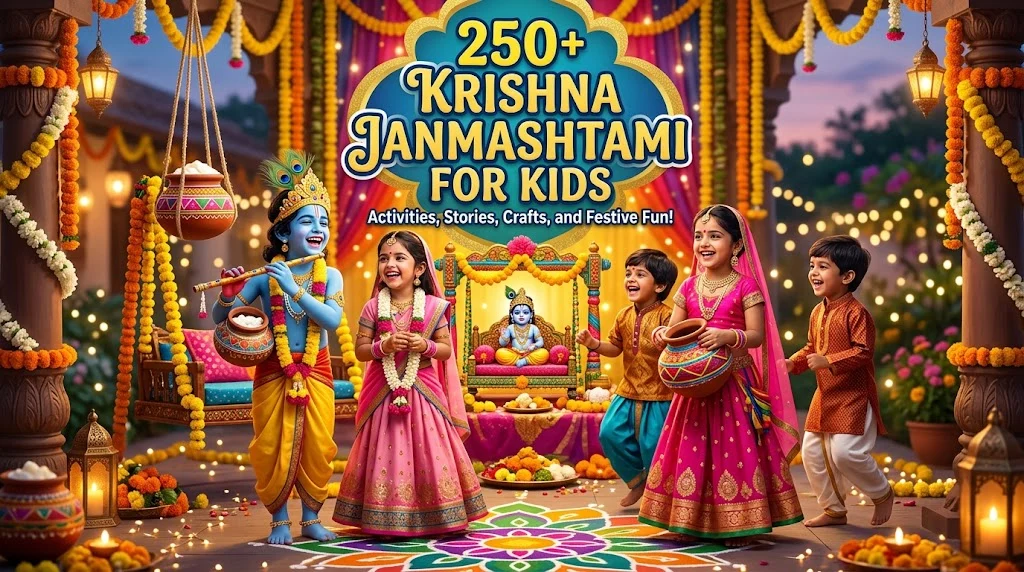
Imagine a small child dressed as little Krishna, holding a tiny flute while the family gathers around a decorated home temple. Soft bhajans play in the background, flowers cover the altar, and everyone waits for the midnight celebration.
This is the special feeling of Krishna Janmashtami for kids. In India, Janmashtami is much more than a religious festival. It is a beautiful time to teach children about Lord Krishna, devotion, faith, love, kindness, courage, and family values. In 2026, Krishna Janmashtami will be observed on Friday, September 4, 2026 in India. The festival brings together ancient traditions and joyful family celebrations.
Children can learn the story of Krishna, make decorations, enjoy devotional songs, dress as Bal Gopal, and understand why people celebrate his divine birth. With simple activities, Janmashtami can become a meaningful and happy experience for every child.
Krishna Janmashtami 2026 Date in India
Krishna Janmashtami is observed on the eighth lunar day, or Krishna Paksha Ashtami, of the dark fortnight in the month of Bhadrapada. In 2026, the main Janmashtami observance in India falls on Friday, September 4. Panchang calculations place the Ashtami period and the midnight birth celebration around this date.
For families planning Krishna Janmashtami for kids, the date is useful for preparing school activities, home decorations, stories, crafts, and simple puja arrangements. Children can also learn that Hindu festivals often follow the lunar calendar, so their dates change from year to year.
Exact Panchang timings can differ from one Indian city to another. Parents should check a trusted city-specific Panchang before planning fasting, puja, or Parana.
- Krishna Janmashtami 2026 falls on Friday, September 4.
- Janmashtami follows Krishna Paksha Ashtami in the Hindu lunar calendar.
- The festival celebrates the divine birth of Lord Krishna.
- Children can learn the festival date through a simple family calendar.
- A small countdown can make the celebration exciting for children.
- Schools can use the date for Krishna-themed cultural activities.
- Families can prepare decorations a few days before the festival.
- Parents can explain why Janmashtami changes dates each year.
- The 2026 celebration offers a wonderful chance to teach children about Indian culture.
Ashtami Tithi, Rohini Nakshatra and Nishita Kaal
Three important terms often appear when people check Janmashtami timings: Ashtami Tithi, Rohini Nakshatra, and Nishita Kaal. Children do not need complicated explanations to understand them. Parents can simply explain that the festival follows specific positions and periods in the traditional Hindu calendar.
For 2026, Panchang calculations show that the Ashtami Tithi and Rohini Nakshatra occur around the Janmashtami observance. In one city-specific Panchang, Ashtami begins on September 4 and ends shortly after midnight on September 5, while Rohini also spans the festival period.
Nishita Kaal refers to the midnight period traditionally chosen for Krishna Puja. Because midnight differs slightly by geographical location, the exact puja window is not identical across India. For example, the listed 2026 Nishita Puja window is around 11:57 PM to 12:43 AM for New Delhi, while other cities have different local times.
- Rohini Nakshatra has a special connection with traditional Krishna birth observance.
- Nishita Kaal refers to the midnight period used for Krishna worship.
- Exact timings depend on the city where the devotee lives.
- Children can learn these terms through a simple calendar activity.
- Parents can explain Tithi as a traditional lunar date.
- A wall chart can show the festival date and midnight celebration.
- Families should avoid copying another city’s exact puja time.
- A trusted local Panchang is best for final timing details.
- Children can learn that Indian festivals combine culture, astronomy, and devotion.
The Beautiful Birth Story of Lord Krishna
The story of Krishna begins in Mathura, where Devaki and Vasudeva were imprisoned by the cruel king Kamsa. A prophecy had warned Kamsa that Devaki’s eighth child would become the reason for his downfall. Because of his fear, Kamsa treated the family harshly.
When Krishna was born at midnight, Vasudeva carried the newborn child away from Mathura. He crossed the Yamuna and took Krishna to Gokul, where Nanda and Yashoda lovingly raised him.
This story is especially meaningful for children because it shows that difficult situations do not have to defeat hope. Krishna’s birth represents courage, protection, faith, and the victory of righteousness over cruelty.
Parents can tell the story slowly and simply. Children can remember the main characters without getting lost in complicated details.
- Devaki was Krishna’s mother and an important figure in his birth story.
- Vasudeva protected Krishna and carried him safely to Gokul.
- Kamsa represents fear, cruelty, and misuse of power in the traditional story.
- Mathura is traditionally associated with Krishna’s birthplace.
- Nanda and Yashoda lovingly raised Krishna in Gokul.
- The Yamuna is part of the famous journey connected with Krishna’s birth.
- Krishna’s birth story teaches children about courage during difficult times.
- The story shows the importance of protecting innocent life.
- Hope remains strong even when circumstances appear frightening.
- Parents can use the story to teach children about courage and righteousness.
Why Janmashtami Is Important for Children
Festivals become more meaningful when children understand the values behind them. Janmashtami gives parents a natural opportunity to discuss kindness, honesty, courage, devotion, duty, and self-control.
Krishna is remembered not only as a playful child but also as a wise teacher and guide. His teachings in the Bhagavad Gita encourage people to perform their duties sincerely and act with wisdom.
For children, these ideas can be explained through everyday examples. Being honest at school, helping a friend, respecting parents, sharing with others, and staying calm during difficult moments are simple ways to connect Krishna’s values with modern life.
- Janmashtami teaches children that faith can bring inner strength.
- Krishna’s childhood stories show the value of joy and innocence.
- His teachings encourage people to perform their duties sincerely.
- Children can learn that courage does not mean never feeling afraid.
- Kindness is one of the easiest Krishna-inspired values to practice.
- Sharing food can become a simple lesson in compassion.
- Helping family members can become a form of service.
- Respecting others teaches children to value every person.
- Self-control helps children make thoughtful choices.
- Positive action can turn spiritual learning into everyday behavior.
Janmashtami Fasting Rules and Parana
Fasting is an important Janmashtami tradition for many devotees, but it is not identical in every family or region. Some people observe a strict fast, while others follow a lighter form of fasting. Religious practices can also differ according to family tradition.
Children should not be expected to copy an adult fasting routine. Young children need regular food, water, and proper nutrition. Parents can involve them in the spiritual side of the fast without making them uncomfortable.
Parana means ending the fast. Traditional rules may consider the ending of Ashtami Tithi and Rohini Nakshatra, while some modern practices break the fast after Nishita Kaal. City-specific Panchang information is therefore important.
- Adults may follow fasting traditions according to their family practice.
- Young children should not be pressured into strict fasting.
- Parents can explain fasting as an act of devotion and discipline.
- Children can enjoy suitable fruits or meals according to family customs.
- Drinking enough water is important for children during celebrations.
- Parana refers to the traditional breaking of the fast.
- Parana timing can depend on the chosen religious tradition.
- Local Panchang details should be checked for the exact Parana time.
- Children can participate in prayers even when they are not fasting.
- The purpose of the festival should remain devotion rather than discomfort.
Krishna Puja and Midnight Birth Celebration
The heart of Janmashtami is the celebration of Krishna’s birth. Many families prepare a small altar with an image or murti of Bal Gopal, the child form of Krishna.
The home may be cleaned and decorated with flowers, leaves, lights, and handmade crafts. During the evening, family members may sing bhajans, read Krishna stories, perform aarti, and prepare traditional offerings.
The main worship is traditionally connected with Nishita Kaal, the midnight period. City-specific Panchang calculations provide different local windows. For example, the 2026 timing listed for Balrampur is about 11:38 PM to 12:23 AM, showing why local timing matters.
- Place a clean cloth beneath the Bal Gopal murti.
- Decorate the puja area with fresh flowers.
- Keep traditional offerings ready before midnight.
- Read a short Krishna birth story with children.
- Sing simple devotional bhajans together.
- Perform a family aarti with care and devotion.
- Offer suitable traditional foods according to family customs.
- Ringing a small bell can make the celebration memorable for children.
- Explain each ritual instead of asking children to follow blindly.
- End the celebration with a peaceful prayer for family well-being.
Mathura Janmashtami and Krishna’s Birthplace
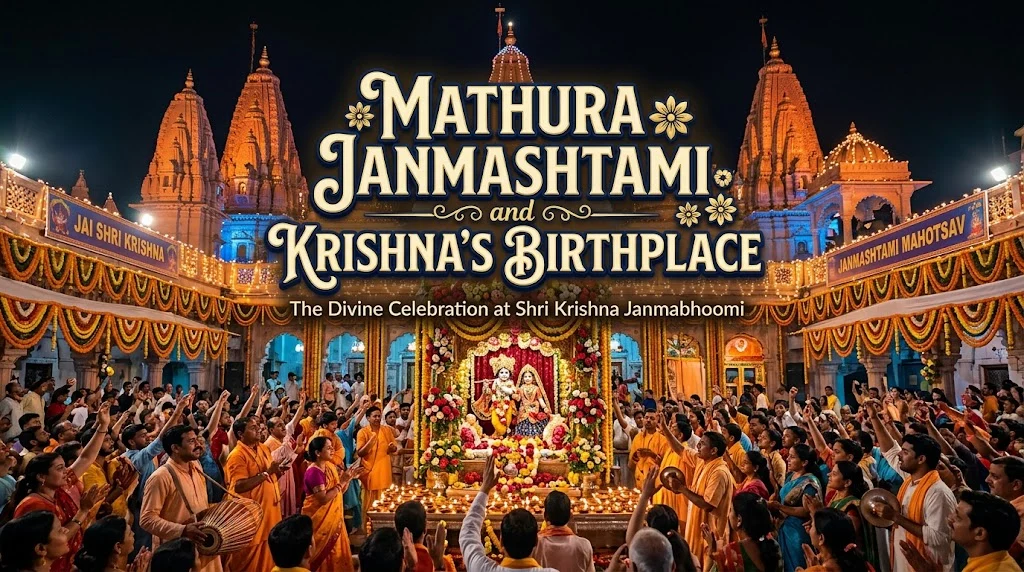
Mathura holds a special place in Krishna devotion because it is traditionally regarded as the place where Krishna was born. During Janmashtami, the city becomes a major center of religious activity.
Temples and devotees organize special prayers, devotional programs, decorations, and midnight celebrations. The atmosphere reflects the deep connection between Krishna’s birth story and the city.
For children, Mathura can be introduced through maps, stories, pictures, and simple geography lessons. Parents can show them where Mathura is located in Uttar Pradesh and explain its connection with Krishna.
- Mathura is traditionally associated with Krishna’s birth.
- Janmashtami brings special devotional activity to the city.
- Temples hold prayers and midnight celebrations.
- Children can locate Mathura on an India map.
- A family story session can explain Mathura’s role in Krishna’s life.
- Parents can teach children about pilgrimage traditions respectfully.
- Mathura helps connect mythology with Indian geography.
- Temple celebrations often include music, prayer, and decorations.
- Children can learn why devotees consider Mathura spiritually important.
- A Mathura-themed craft can become a fun Janmashtami activity.
Vrindavan and Gokul Janmashtami Traditions
After Krishna’s birth, his childhood is closely associated with Gokul, while Vrindavan became deeply connected with his later childhood stories and devotion. Both places are important centers of Krishna worship.
Vrindavan is known for its many temples, devotional traditions, bhajans, and Radha Krishna worship. Gokul is remembered for stories of Krishna’s playful childhood and his loving relationship with Nanda and Yashoda.
For children, these places can make the festival story feel like a journey. Parents can explain how different locations are connected with different parts of Krishna’s traditional life.
- Gokul is strongly connected with Krishna’s childhood.
- Vrindavan is famous for deep Krishna and Radha Krishna devotion.
- Children can learn about both places through a simple map.
- Krishna’s childhood stories often focus on playfulness and love.
- Family storytelling can bring Gokul traditions closer to children.
- Temple visits can introduce children to devotional culture.
- Vrindavan is known for its many Krishna temples.
- Gokul traditions highlight Krishna’s loving family environment.
- Children can draw a simple Mathura, Gokul, and Vrindavan route.
- Regional traditions may differ, so families can celebrate in their own way.
Dahi Handi and Maharashtra Janmashtami Celebrations
Dahi Handi is one of the most energetic Janmashtami traditions in India. It is especially associated with Maharashtra, where groups form human pyramids to reach and break a pot filled with curd or other offerings.
The tradition is inspired by stories of young Krishna and his love for butter and curd. Modern Dahi Handi events can be large community celebrations, while families can create safer child-friendly versions at home.
In 2026, Dahi Handi is listed for Saturday, September 5 in the cited Panchang data.
- Dahi Handi is strongly associated with Maharashtra.
- The tradition reflects stories of Krishna’s playful childhood.
- Community groups often work together to form human pyramids.
- Children can learn that teamwork is central to the tradition.
- Families can make a simple paper pot for a craft activity.
- A child-friendly celebration should avoid unsafe climbing.
- Traditional curd-based foods can be prepared at home.
- Parents can explain the cultural meaning behind Dahi Handi.
- Community celebrations may be larger than home celebrations.
- The tradition shows how Krishna’s childhood stories became living culture.
Janmashtami Traditions Across Different Parts of India
India celebrates Janmashtami in many different ways. The central devotion remains connected with Krishna, but local customs, foods, music, decorations, and temple practices can vary.
Some families focus on fasting and midnight puja. Others emphasize devotional singing, temple visits, children’s performances, Krishna costumes, or community gatherings.
This variety is one of the beautiful parts of Indian culture. Children can learn that there is not only one correct way to celebrate a festival. Respect for regional and family traditions is itself an important lesson.
- Families in different regions may follow different Janmashtami customs.
- Some communities organize large temple celebrations.
- Others prefer quiet family worship at home.
- Devotional singing is common in many celebrations.
- Children may dress as Krishna or Radha for cultural programs.
- Traditional foods can differ from one region to another.
- Some places give special importance to Dahi Handi.
- Temple decorations often become a major part of the festival.
- Family traditions should be respected even when they differ.
- Indian diversity makes Janmashtami celebrations rich and colorful.
Radha Krishna Devotion, Bhajans and Spiritual Learning
Janmashtami is closely connected with Radha Krishna devotion. Their stories are often used to express deep love, devotion, surrender, and spiritual connection.
Bhajans can make the celebration peaceful and engaging for children. Parents do not need to choose complicated songs. Simple devotional music can be enough to introduce children to the atmosphere of the festival.
Spiritual learning should feel natural. A short story, a meaningful prayer, or a discussion about kindness can teach more than a long lecture.
- Radha Krishna devotion is an important part of Krishna-centered traditions.
- Bhajans can create a peaceful family atmosphere.
- Children can learn simple devotional songs.
- Parents can explain devotion through examples of love and respect.
- A short prayer can become part of a child’s daily routine.
- Krishna stories can encourage children to think about good choices.
- Music can make spiritual learning enjoyable.
- Family singing creates a shared festival memory.
- Children can draw Radha Krishna-inspired artwork.
- Devotion can be explained as love, faith, and sincere connection.
Krishna Janmashtami Decorations and Family Activities
Children love festivals when they can take part. Instead of only watching adults prepare everything, parents can give children small and safe responsibilities.
They can make paper flowers, decorate a Krishna corner, prepare a peacock-feather craft, draw tiny footprints, or create a simple flute-themed decoration. These activities turn Janmashtami into a hands-on learning experience.
Families can also organize storytelling, devotional music, Krishna quizzes, and traditional games. The goal is not perfection. The goal is to create a warm memory around faith and family.
- Make paper flowers for the home temple.
- Create tiny Krishna footprints near the puja area.
- Use safe decorations that children can handle easily.
- Make a cardboard flute as a simple craft project.
- Draw peacock feathers using colored paper.
- Read one Krishna story together before bedtime.
- Organize a small Krishna costume activity.
- Let children help arrange flowers under supervision.
- Create a family Janmashtami photo corner.
- End the activity with a short family prayer.
Janmashtami Food and Traditional Offerings
Food is an important part of Indian festivals, and Janmashtami is no exception. Families may prepare fruits, milk-based dishes, sweets, makhan, curd, panjiri, and other traditional offerings depending on their region and family customs.
For children, food can become another way to understand culture. Parents can explain why certain ingredients are offered and how different families prepare special festival dishes.
There is no need to make a huge menu. A few thoughtfully prepared dishes can create a meaningful celebration.
- Fresh fruit can be included in the festival offerings.
- Milk-based foods are common in many Krishna traditions.
- Makhan is linked with beloved childhood stories of Krishna.
- Homemade sweets can make the family celebration special.
- Traditional recipes can be passed from grandparents to children.
- Children can help wash fruit under adult supervision.
- Families can prepare a small offering instead of wasting food.
- Regional recipes can introduce children to Indian food diversity.
- Prasad can be shared respectfully with family members.
- Food should support the joy of celebration without unnecessary waste.
Janmashtami Wishes, Krishna Quotes and Status Ideas
Janmashtami wishes are a simple way to share the spirit of the festival with friends and family. A good message does not need complicated words. It can focus on peace, love, faith, kindness, and happiness.
Children can also create their own messages for grandparents, teachers, cousins, and friends. This gives them a chance to practice gratitude and express good wishes.
Short Krishna status messages work well for social media, messaging apps, greeting cards, and family groups.
- May Krishna fill your home with peace, love, and happiness.
- May faith give you strength during every difficult moment.
- May Krishna guide your heart toward kindness and wisdom.
- Wishing your family a peaceful and joyful Janmashtami.
- May the blessings of Bal Gopal bring happiness to every home.
- Let this Janmashtami remind us to choose love over fear.
- May Krishna inspire us to do our duties with sincerity.
- Wishing everyone a beautiful celebration filled with devotion.
- May the spirit of Krishna bring hope and positivity into your life.
- Celebrate Janmashtami with faith, kindness, family, and a grateful heart.
Krishna Janmashtami Celebration Ideas for Kids
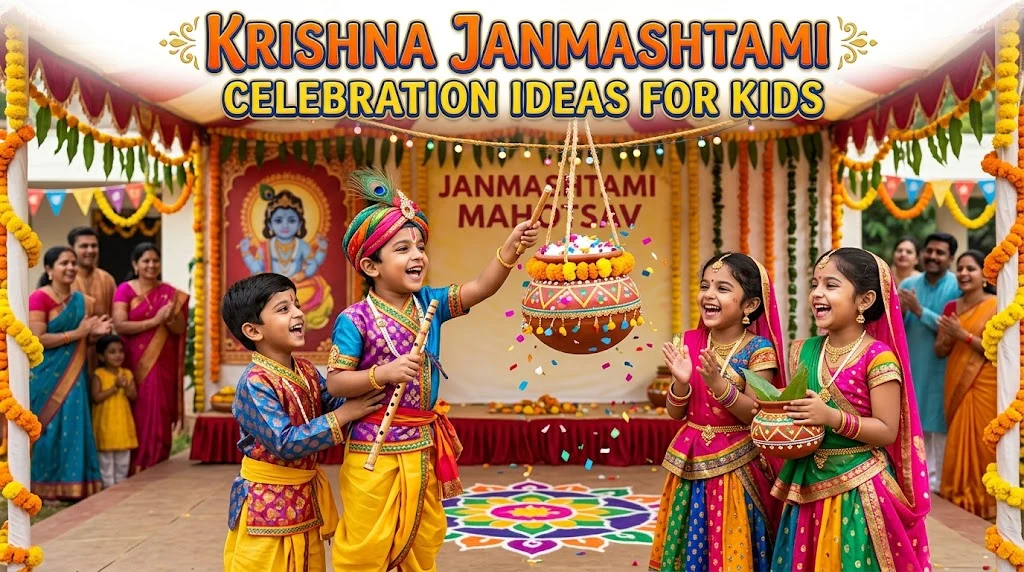
The best Krishna Janmashtami for kids celebration is one that combines learning with fun. Children should feel involved rather than simply being told to sit quietly during adult rituals.
A simple plan can include a Krishna story, costume activity, craft session, devotional song, family prayer, and healthy festive food. Older children can help younger siblings understand the story.
Parents can also create a small treasure hunt based on Krishna’s childhood stories. This makes the festival interactive while still keeping its cultural meaning.
- Organize a simple Krishna costume day at home.
- Create a small Janmashtami storytelling circle.
- Make paper crowns inspired by Krishna’s traditional appearance.
- Let children decorate a safe home altar.
- Organize a Krishna-themed drawing competition.
- Prepare a short family bhajan session.
- Make a simple Dahi Handi craft without climbing.
- Create a quiz about Krishna’s childhood story.
- Ask children to write one positive value they learned from Krishna.
- Finish the celebration with family prayers and shared prasad.
Janmashtami Captions, Krishna Status and Family Messages
Social media has become another way for families to share festival memories. A Janmashtami caption can be short, meaningful, and personal.
For children, captions can focus on innocence, devotion, family happiness, and the playful spirit of Bal Krishna. Parents can also use family photos, costume pictures, decoration shots, or temple visits to create memorable posts.
The strongest captions are usually simple. They do not need too many words or complicated religious references.
- Celebrating the divine joy of Krishna with family and faith.
- Little Krishna, big happiness, and beautiful family memories.
- Janmashtami is a celebration of love, devotion, and hope.
- A peaceful heart makes every festival more meaningful.
- Keeping Krishna close through faith, kindness, and love.
- Childhood memories become sweeter when festivals are celebrated together.
- Celebrating Bal Gopal with a heart full of gratitude.
- Krishna’s story reminds us that hope can overcome fear.
- A family celebration becomes a lifelong memory.
- Let this Janmashtami bring more kindness into our lives.
Teaching Krishna Values Through Everyday Life
The deepest lesson of Krishna Janmashtami for kids is not simply learning when the festival occurs. It is learning how Krishna’s values can influence everyday behavior.
Children can understand spirituality through ordinary actions. Helping someone, speaking truthfully, sharing food, respecting elders, completing responsibilities, and staying calm during problems are all practical lessons.
The Bhagavad Gita is especially important for Krishna’s teachings. Parents can introduce its ideas in age-appropriate language rather than overwhelming children with difficult philosophical concepts.
- Teach children that honesty builds trust.
- Show them that kindness can begin with small actions.
- Encourage them to complete responsibilities without constant reminders.
- Explain that courage means doing what is right even when it is difficult.
- Help children understand why self-control matters.
- Encourage sharing instead of unnecessary competition.
- Teach respect through everyday family interactions.
- Use Krishna stories to discuss choices and consequences.
- Remind children that mistakes can become opportunities to learn.
- Make Janmashtami a starting point for positive habits throughout the year.
Conclusion
Krishna Janmashtami 2026 is a beautiful opportunity for Indian families to celebrate faith, culture, devotion, and togetherness. The festival will be observed on Friday, September 4, 2026, with the main midnight worship connected with the traditional birth of Lord Krishna. Exact Nishita Kaal, fasting, and Parana timings vary by city, so families should check a reliable local Panchang before following specific rituals.
The story of Krishna’s birth, from Devaki and Vasudeva in Mathura to Nanda and Yashoda in Gokul, carries powerful lessons about hope, courage, faith, and righteousness. Mathura, Vrindavan, and Gokul continue to hold a special place in Krishna devotion, while Maharashtra is known for its lively Dahi Handi tradition.
For children, the festival can be simple and joyful. A Krishna story, a small decoration, a bhajan, a family prayer, a traditional offering, or a Krishna-themed craft can create lasting memories. Most importantly, Janmashtami can teach children to choose kindness, love, courage, duty, and positive action.
That is the lasting beauty of Krishna Janmashtami for kids: the celebration may last one day, but its values can stay in the heart for life.
Frequently Asked Questions
When is Krishna Janmashtami in India in 2026?
Krishna Janmashtami will be celebrated in India on Friday, September 4, 2026. The festival is associated with Krishna Paksha Ashtami and the traditional midnight birth celebration. Exact puja timings can vary by location, so families should check their local Panchang for the final Nishita Kaal and other ritual timings.
What is the Nishita Kaal for Janmashtami 2026?
Nishita Kaal is the midnight period traditionally used for Krishna Puja. In 2026, its exact timing differs across Indian cities because Panchang calculations depend on local geographical conditions. For example, New Delhi has a listed window of about 11:57 PM to 12:43 AM, while other cities have different timings.
Why is Krishna Janmashtami celebrated?
Janmashtami celebrates the traditional birth of Lord Krishna, who is revered as an important divine figure in Hinduism. His life and teachings are associated with devotion, dharma, wisdom, courage, compassion, and righteous action. For children, the festival is also a meaningful way to learn about Indian culture and positive values.
How do people celebrate Janmashtami in India?
People celebrate Janmashtami in many ways. Common traditions include fasting, Krishna Puja, midnight worship, bhajans, aarti, temple visits, decorations, traditional offerings, and storytelling. Children may dress as Krishna or Radha. Maharashtra is especially known for Dahi Handi, while Mathura, Vrindavan, and Gokul have strong Krishna devotional traditions.
What are the best Janmashtami wishes and captions for 2026?
The best Janmashtami wishes are simple and heartfelt. Messages about peace, faith, love, kindness, family, and Krishna’s blessings work well for social media and family greetings. For children, short captions about Bal Gopal, happiness, devotion, and Krishna’s playful spirit can make photos and celebration memories feel more personal.